Artgurl Articles
Because... When arts fail, I gotta use my words.
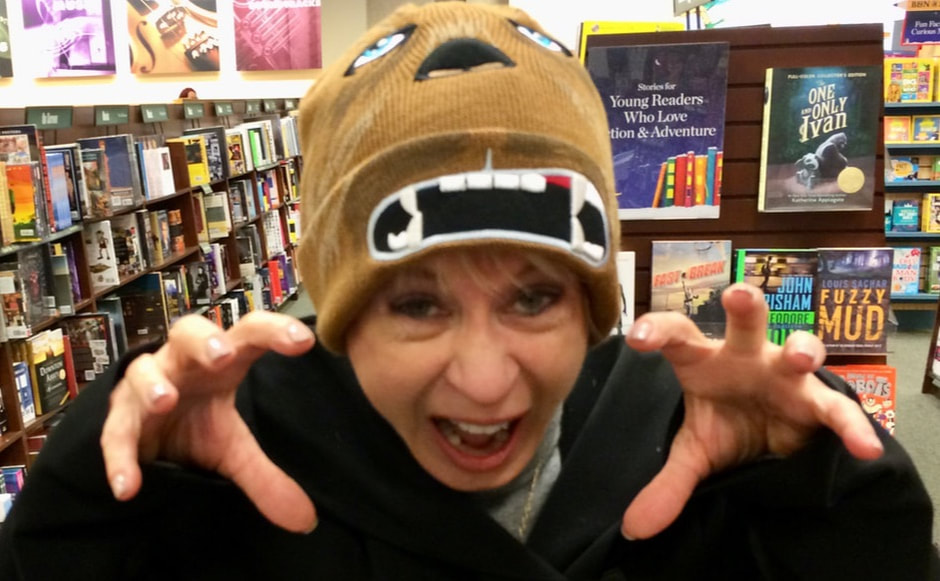 So much has changed over the last year. We’ve adapted to new rules. We’ve adjusted behaviors and restructured lives. It’s been a bleak Spring and a parched Summer sandwiched between two cold, hard Winters.Gratefully, the end is nearly in sight. Remember when restrictions had eased and retail stores began to open again? Didn't it feel as though we emerged from our burrows a little kinder to one another? Employees, who hadn’t seen customers or clients in months, seemed friendlier. Customers, who’d desperately missed Mall Crawls and Retail Therapy, didn’t seem to care that inventory was lacking. We were simply grateful to have a small slice of “normal” to savor. Although my outlook remains hopeful––the vaccines are getting into the arms that want them, the economy is faring better than expected, and Trump is still not tweeting–– I’ve sensed a retro-shift. Our mid-pandemic largess might be wearing a little thin. Still, Spring is here, flowers are in bloom, and the weather in Sacramento is glorious. A perfect day, I decided, to venture out “amongst them”. My mission statement: black espadrilles. Nothing fancy. Reasonably priced. 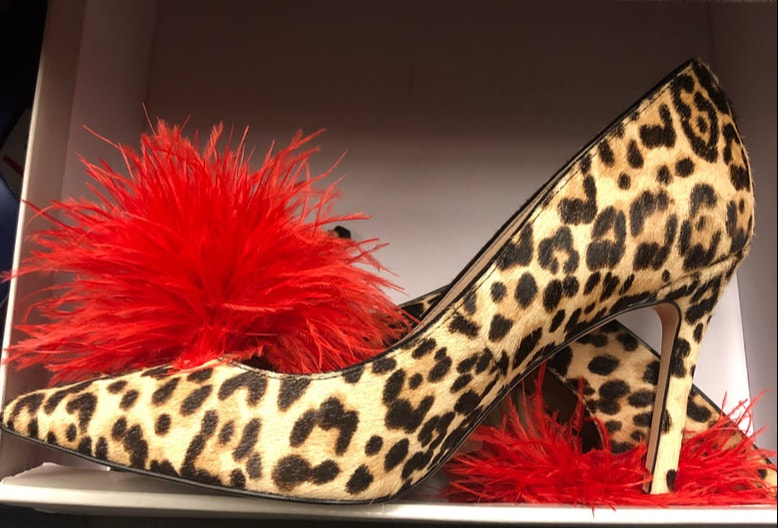 I found no joy at Sacks Off Fifth 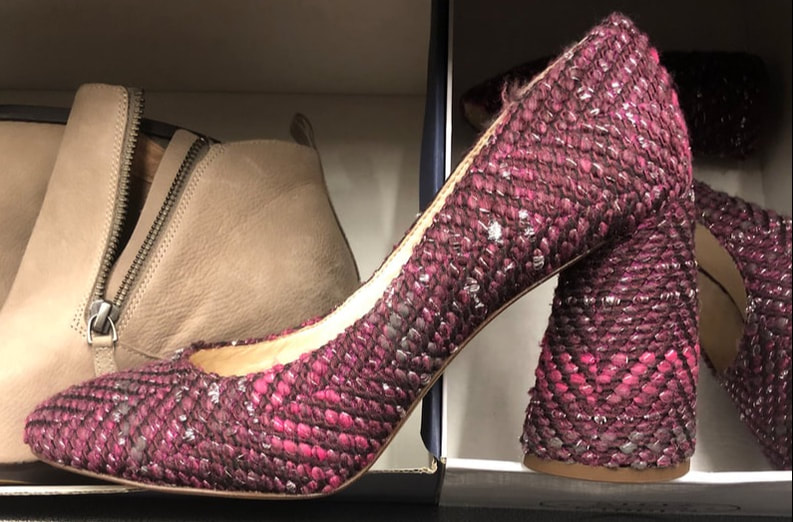 Or the Rack 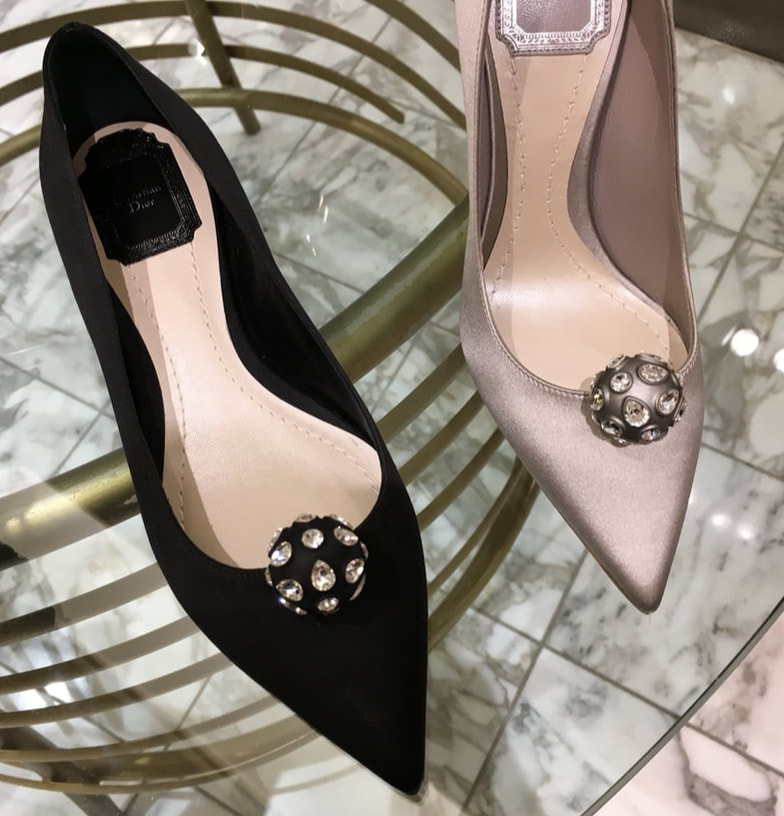 Or Nordstrom. 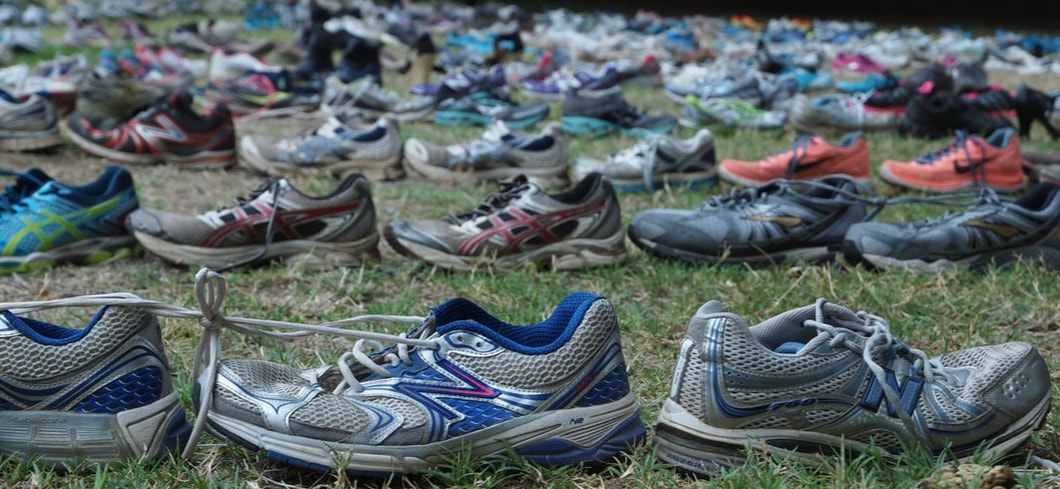 But what about Macys? Shopping, for me, is like the hunt; the expedition doesn’t always deliver a kill yet when prey is detected and within arm’s reach, it can be exhilarating. And this, Dear Reader, is where our tale begins. 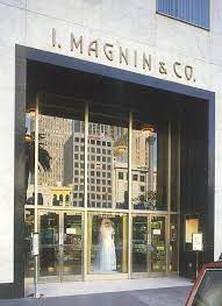 First let me explain that I have experienced both sides of the counter. In my youth in Southern California (first as a 15 year old Christmas extra and then through high-school and college as a part-time-sales-associate) I was employed by I. Magnin and Company, a once-upon-a-time department store. When I moved to Sacramento in 1986, they hired me again, as a full time employee. In the Cro-Magnin era, sales associates had criteria: greeting Customer entering one’s department, learning what Customer requires and offering assistance, if Customer wishes to browse unassisted, don’t hover but do pay attention. Always be courteous, especially when taking returns. Know your inventory. Finally, comportment; think Ms.Hughes a.k.a. Elsie Carson, head housekeeper at Downton Abbey. Fast forward to today: 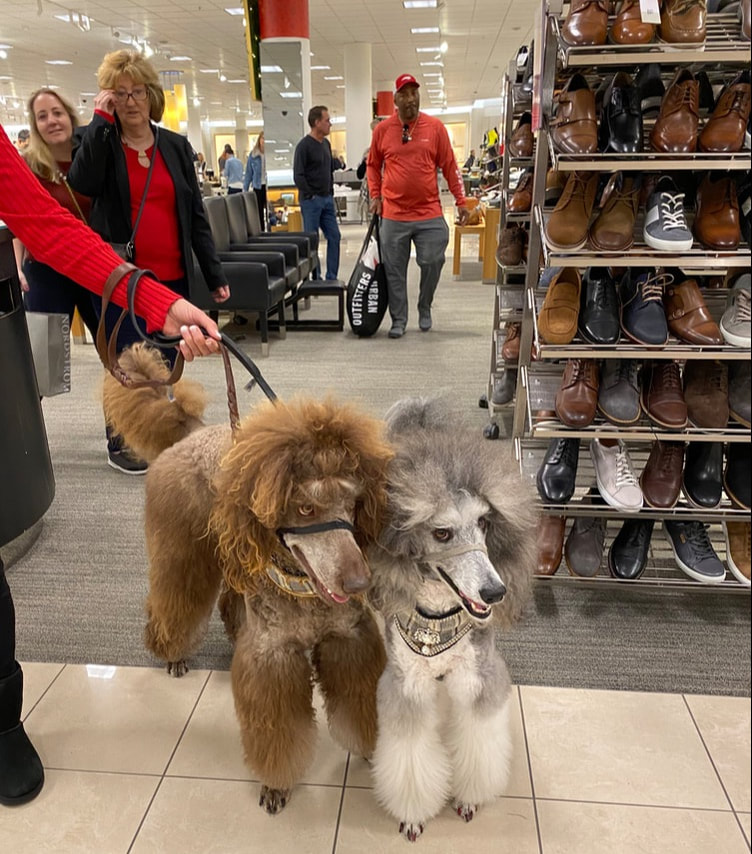 Sunrise Macy’s wasn’t nearly as busy as the other stores. During the time it took to make one leisurely lap around the shoe department, I saw only two other women loitering by the sale rack and a young girl trying on adult slippers. A thin guy behind the register was focused on his cell phone and the twenty-something I’d profiled as a customer in too-tight jeans and gangsta hoodie, picked up a stack of boxes and disappeared into the stock room. With an espadrille in each hand, I wandered and waited and when Twenty-Something appeared again, I held up the shoes. She stacked up some more boxes before muffled words came out of her mask. It sounded like, “Yeah, be back in a minute.” I was just about to approach Thin Guy at the register when Twenty-Something came up behind me. “What size?” she asked. “ An Eight...probably,” I said as I turned. “I’m looking for espadrilles. In black.” I’d offered up this last tidbit because, in Cro-Magnin times, when a customer told The Shoe Guy what she wanted, Shoe Guy would return with multiple boxes, pulling anything and everything from the stockroom that resembled the parameters. I. Magnin Shoe Guys worked on commission and they were ruthless.
Twenty-Something was gone quite awhile. Which made me feel hopeful.  Sadly, she returned with only two boxes. “There aren’t a lot of this one left," she said, " ‘Cause they’re pretty popular. We have lots of the other, though.” She dropped the boxes next to me and left. Back in the day, Shoe Guy would present a shoe. He eased it from the box on bended knee, just like Prince Charming offering up a glass slipper—because, back in the stock room, Shoe Guy had already buffed the merchandise. He’d removed the plastic or tissue-paper wadding, and the plastic stretcher-sticks and cardboard reinforcers. Anything that might distract from his choreographed Cinderella presentation . 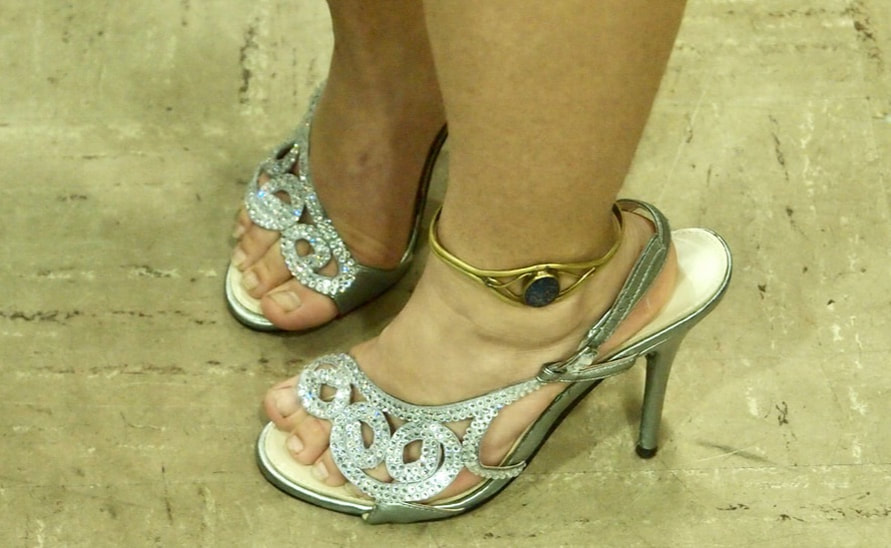 Yet Twenty-Something, being the twenty-something she was, couldn’t possibly know of these antiquated rituals, so it was up to me to do the tearing of plastic and tissue and removing of wadding and spacers. Surprisingly, the “popular shoe” wasn't quite right when I got it on. The other was too big so I looked around for Twenty but she was elsewhere--doing something very important, I’m sure-- so I went to the register and asked Thin Guy if the shoe came in half sizes. He put down his phone to check the computer. “Yep, 7.5. We have ‘em, there in the back,” he said, just as Twenty-Something arrived on the scene.“Lady wants a seven and a half,” he said to his co-worker. “Yeah,” Twenty-Something replied, “Everyone says they run big.” Back in the day, if Shoe Guy knew that a style ran small or large or wide or narrow, he’d bring two, sometimes three, identical shoes but in different sizes. Shoe Guy was efficient. He lived to sell shoes and make commissions. On the bright side, Twenty Something was going to get her steps in today.  Again I waited as Twenty-Something brought out the smaller shoe. Again I removed the plastic, paper, tape, stretchers, and wadding and, when I finally got them on my feet, they were perfect! I glanced at the considerable pile of shredded packing material on the seat and floor next to me and thought: I am Lioness. Witness my kill. I gathered up the box and approached the register. When I handed my Visa to Twenty, her eyebrows shot above her mask. “You should use your Macy’s,” she said. “Don't you want the points?” Once upon a time, sales associates asked, “How would Madame prefer to pay?” “I’ll use my Visa, thanks.” And then I saw it. Eye roll. Facial gesture that no pandemic mask can conceal. I opened my mouth to say what I knew I’d regret. “The reason I’m not using my Macy’s is because I tore it up, right after my last shopping experience, in this same store, a couple of years ago. I vowed I’d never come here again. But then came the lockdown, and we were all starved for connection, and even though some suffered a whole lot and others suffered a little less, all of us looked for small ways to be a little kinder, and friendlier, and more patient. And we cherished small moments of gratitude, so when I was out today—shopping at all of your competitors, by the way—I thought to myself, stores are really hurting right now and it’s silly to hold a grudge and maybe I’d rushed to judgment on poor old Macy’s. But I was so wrong! With this brand of in store customer service, everyone will be shopping on line. ” I didn’t say it, though. Which is why I’m Caren with a C. Not Karen with a K. 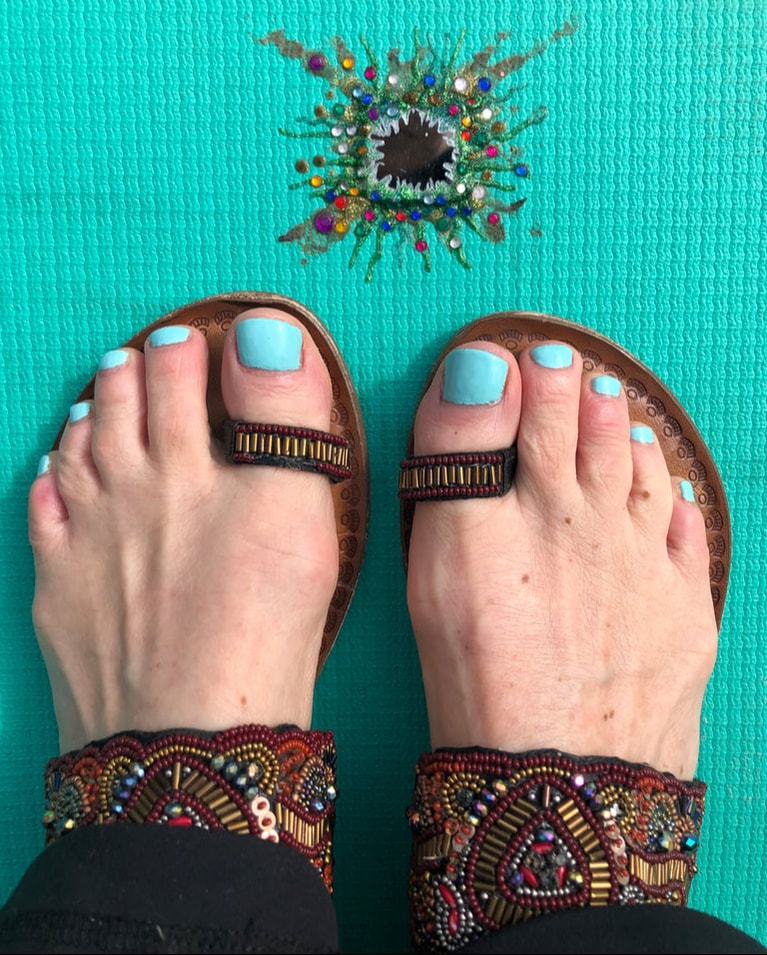
8 Comments
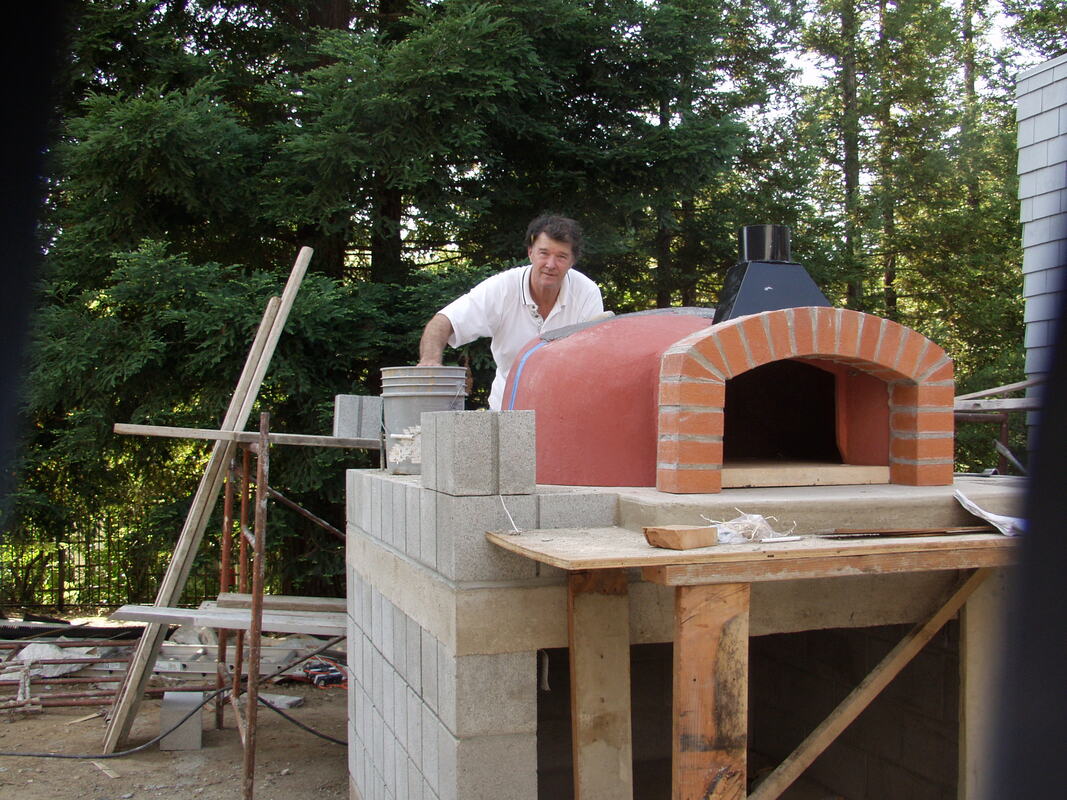
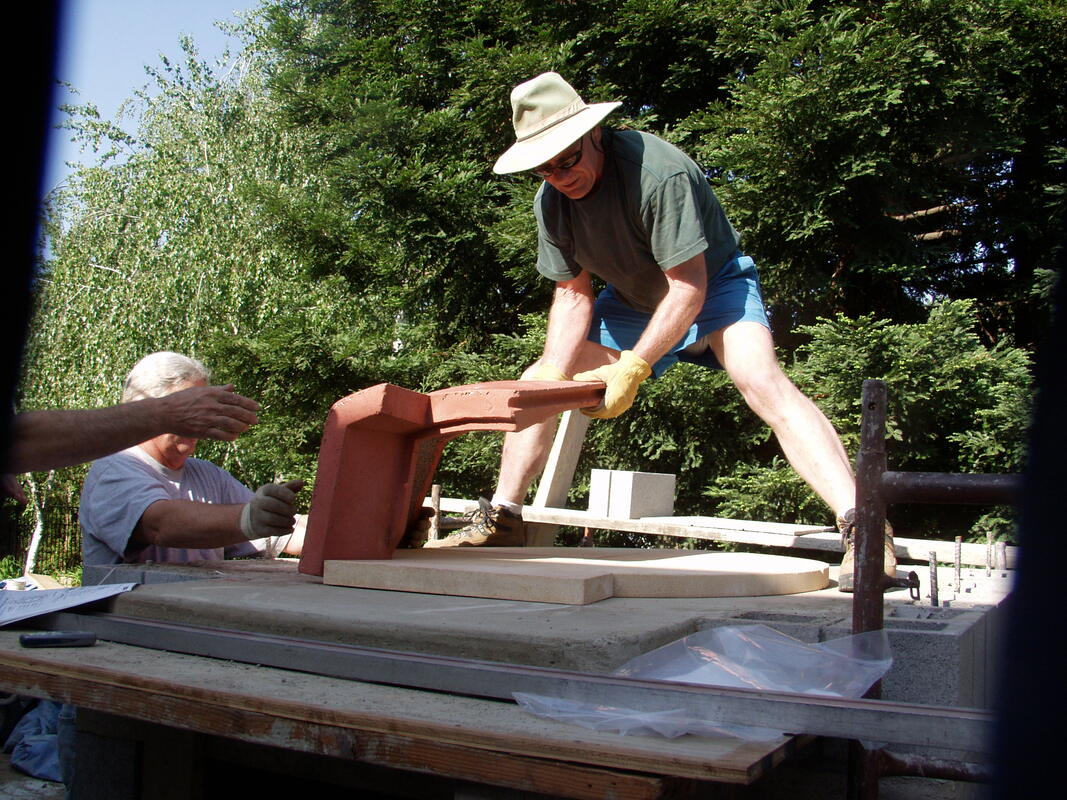
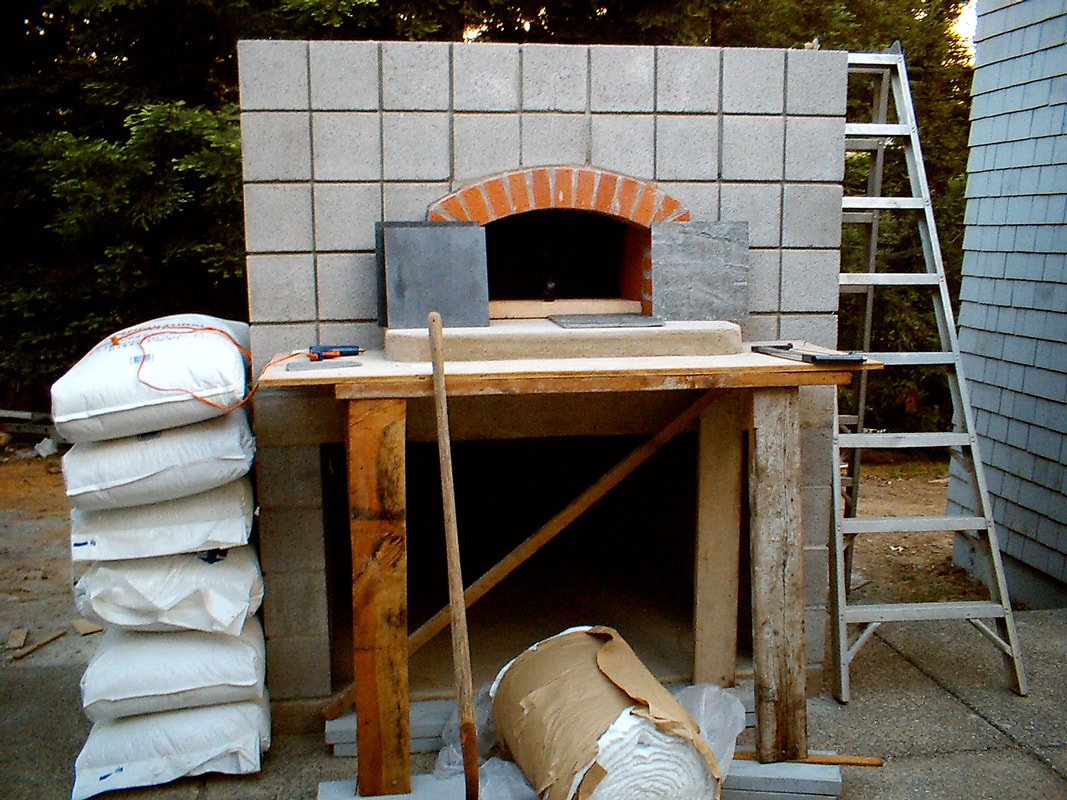
 A Long Time Ago in a Galaxy Far Away… To be clear, the year was 2004 and the galaxy was Fair Oaks, California. That’s when we built the pizza oven. To be truthful, we didn’t build it by ourselves. It took a village.
The oven itself, which came all the way from Italy, was a terra-cotta contraption of eight interlocking parts that needed to be “housed” yet the written instructions were somewhat cryptic on this point. The manufacturer assumed that EVERYONE in 2004 knew what a finished pizza oven should look like. Having endless imagination confined by a restricted budget, we used cinderblock. My one aesthetic contribution: Glazed tiles. The A to Z of pizza toppings. 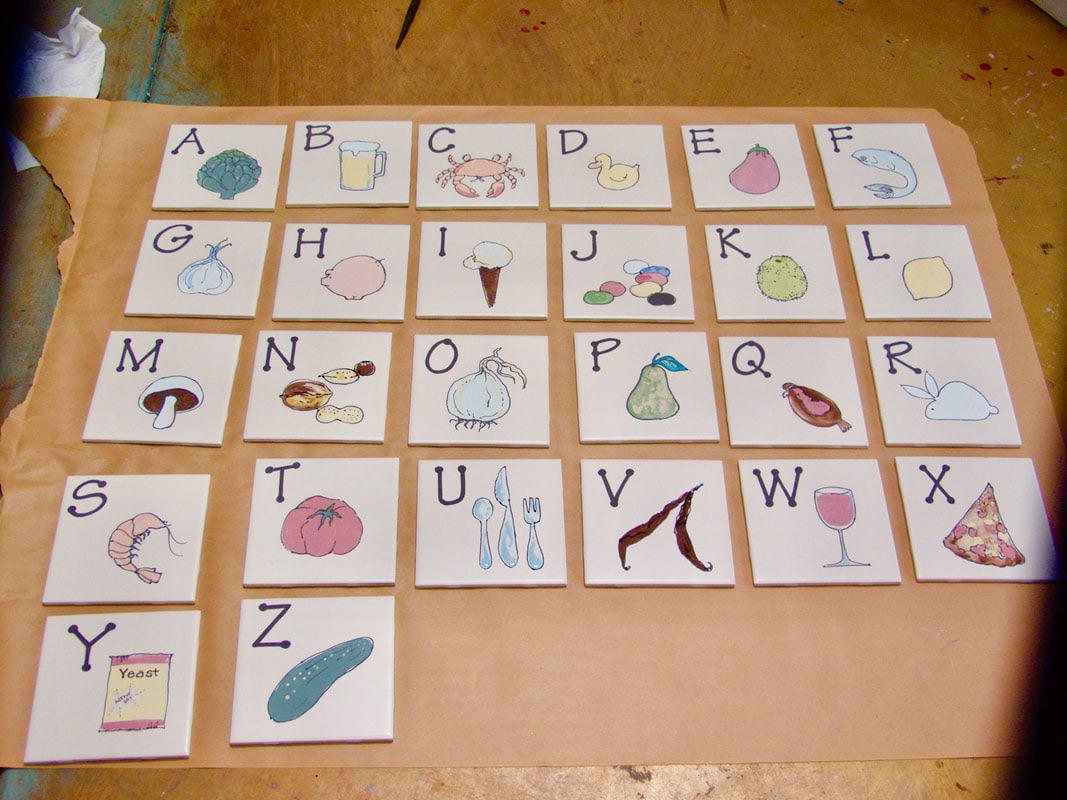 For 17 years , our 8x8x8 cinderblock behemoth, with it’s skinny- belt of alphabet tiles, pumped out pizzas. It fed our friends and warmed our hearts. Then came the pandemic. 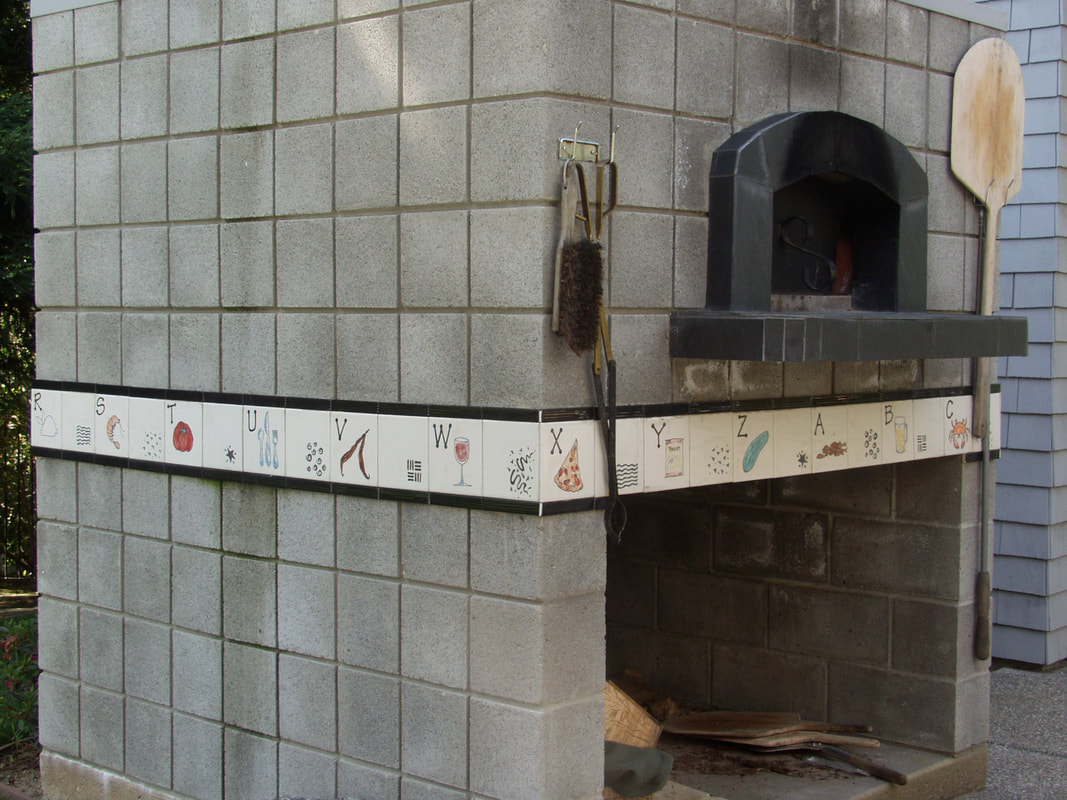 The downside and upside of “sheltering at home”: it invites scrutiny while offering permission. During our last 30 years of household renovations, I’ve saved stuff: extra tile, broken mirror, leftover lumber.Are all artists hoarders? Perhaps. Or, like the Wicked Witch of the West, are we simply biding our time? For years, these boxes of building materials had been taking up space in our shed.So, when I asked my spouse “What would you think if I used that leftover tile on the pizza ov–“ “You go, gurl! ” He said. 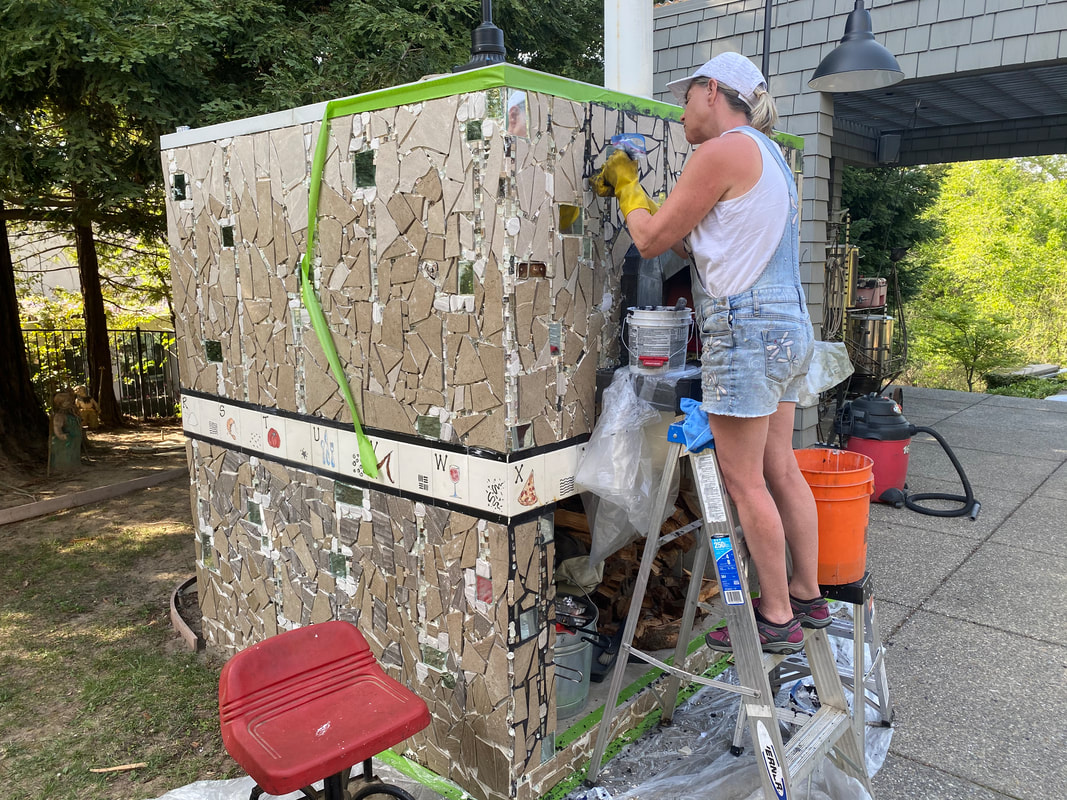 Happily, some fully vaccinated wizards of my acquaintance dropped by to offer their assistance which, for one halcyon Tuesday afternoon, made life feel almost like normal again. Grateful thanks to Dianne Van der Carr, Marilynn Rasmussen, Ann O' Connell and Abby the Wonder Dog. 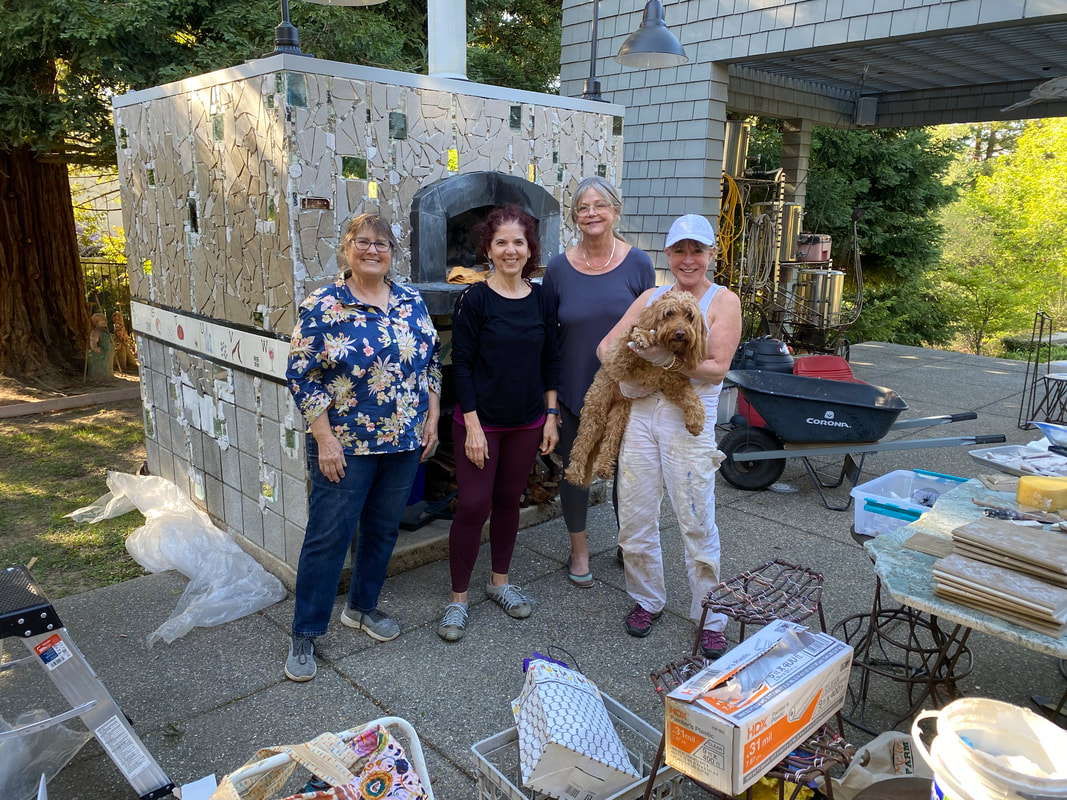 The finished product: :Mirror, broken ceramic tile, pebbles, and glass. Black slate interior. 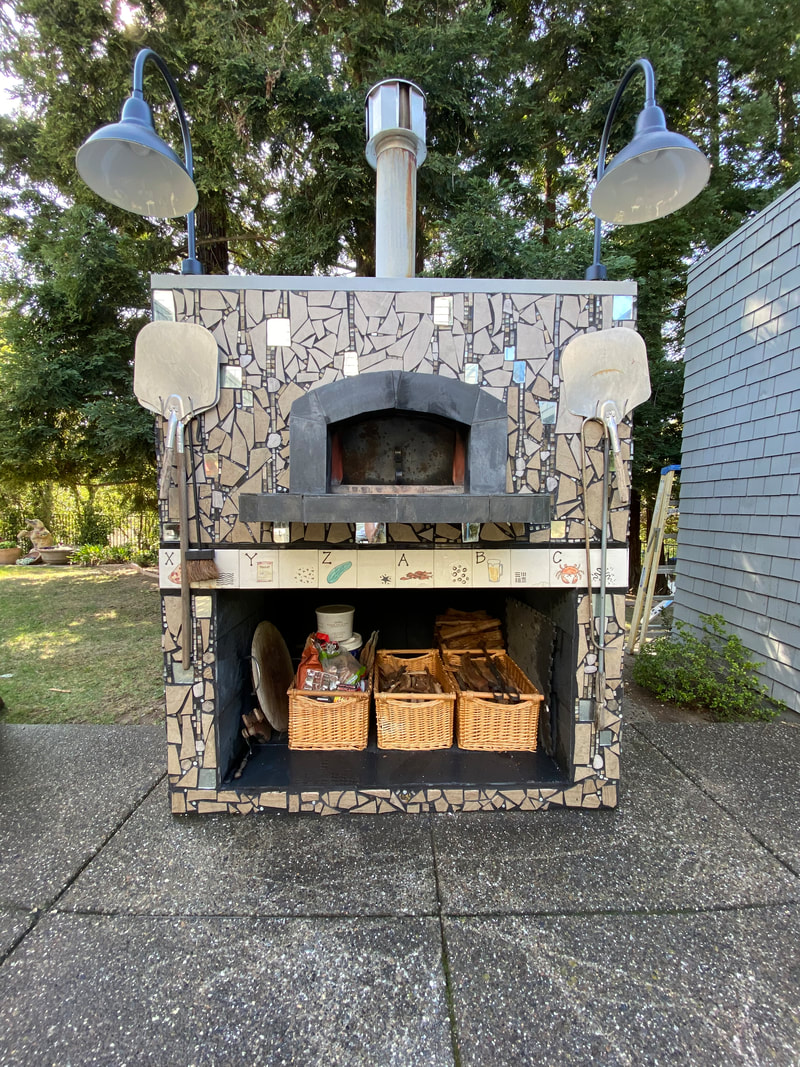 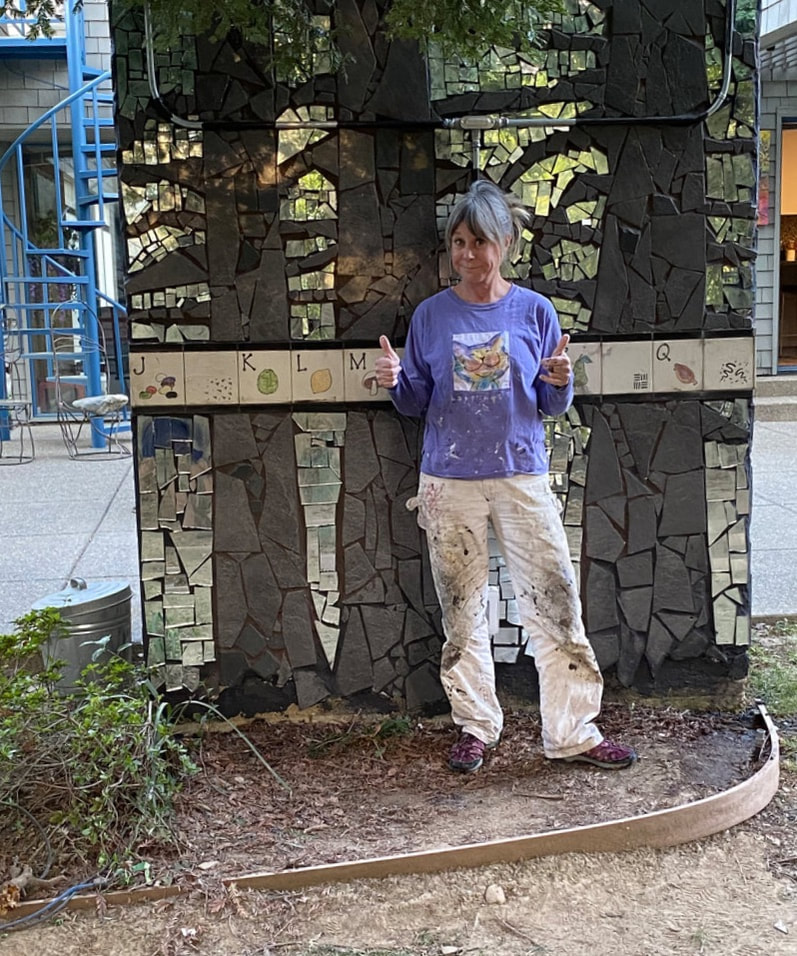 The Back: A mural. Just because.
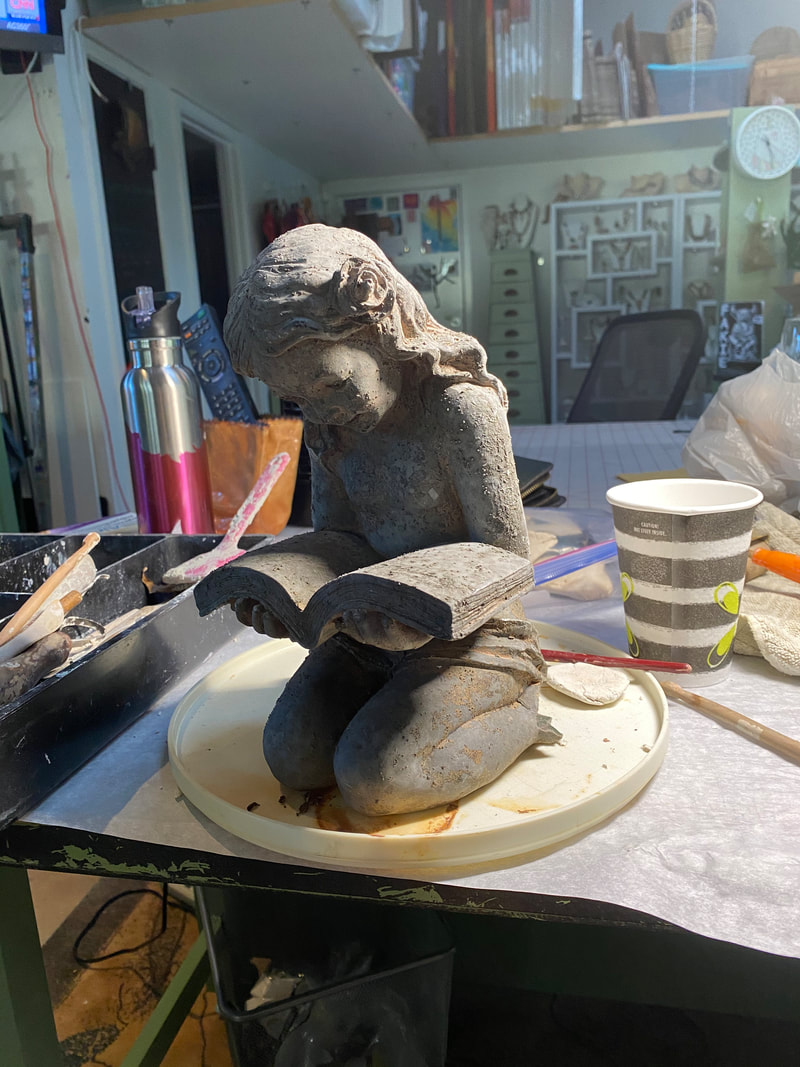
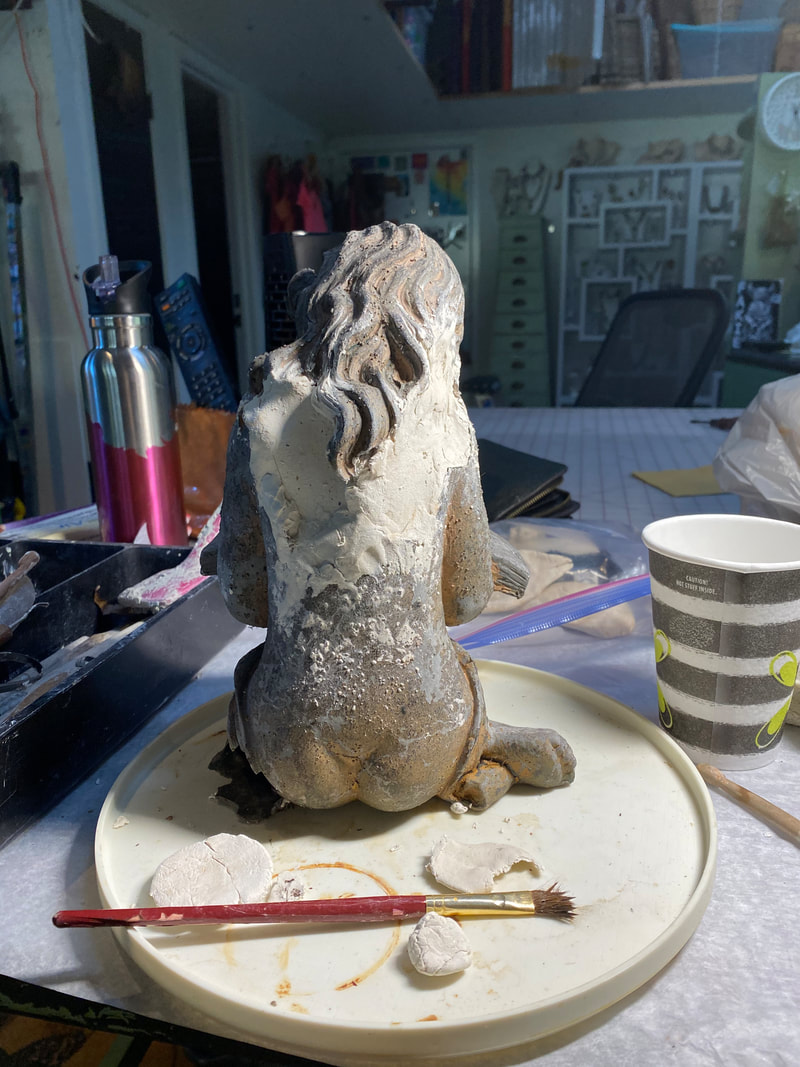
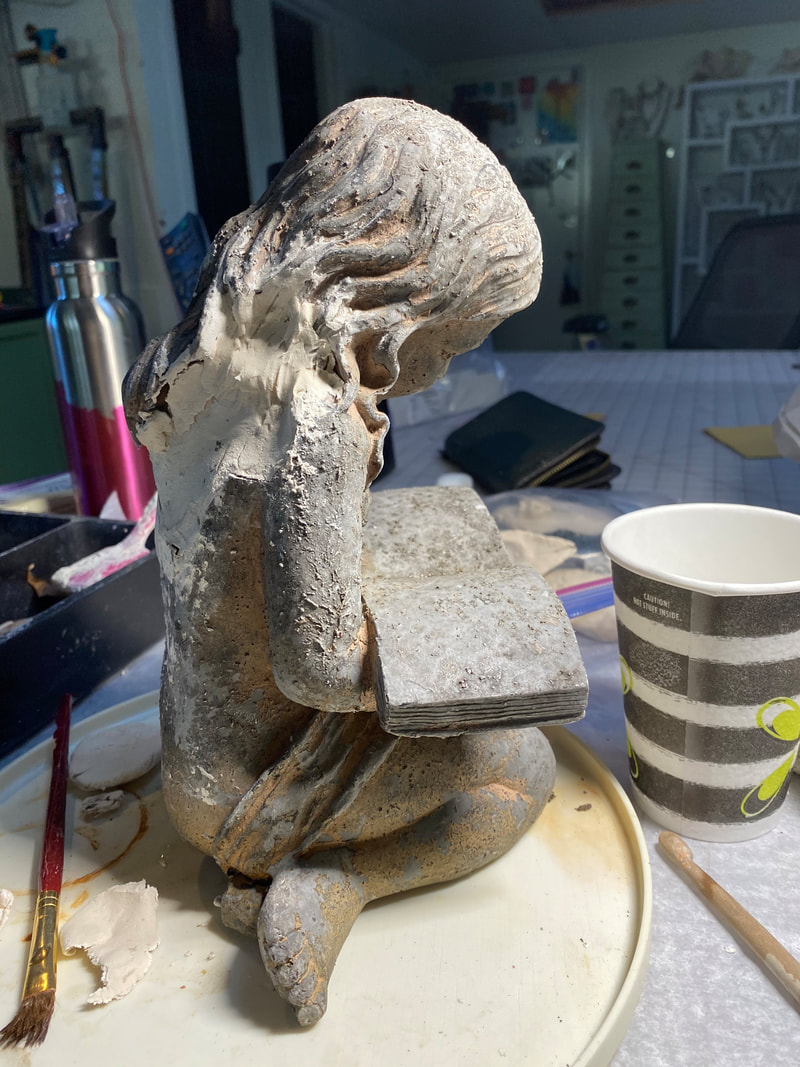
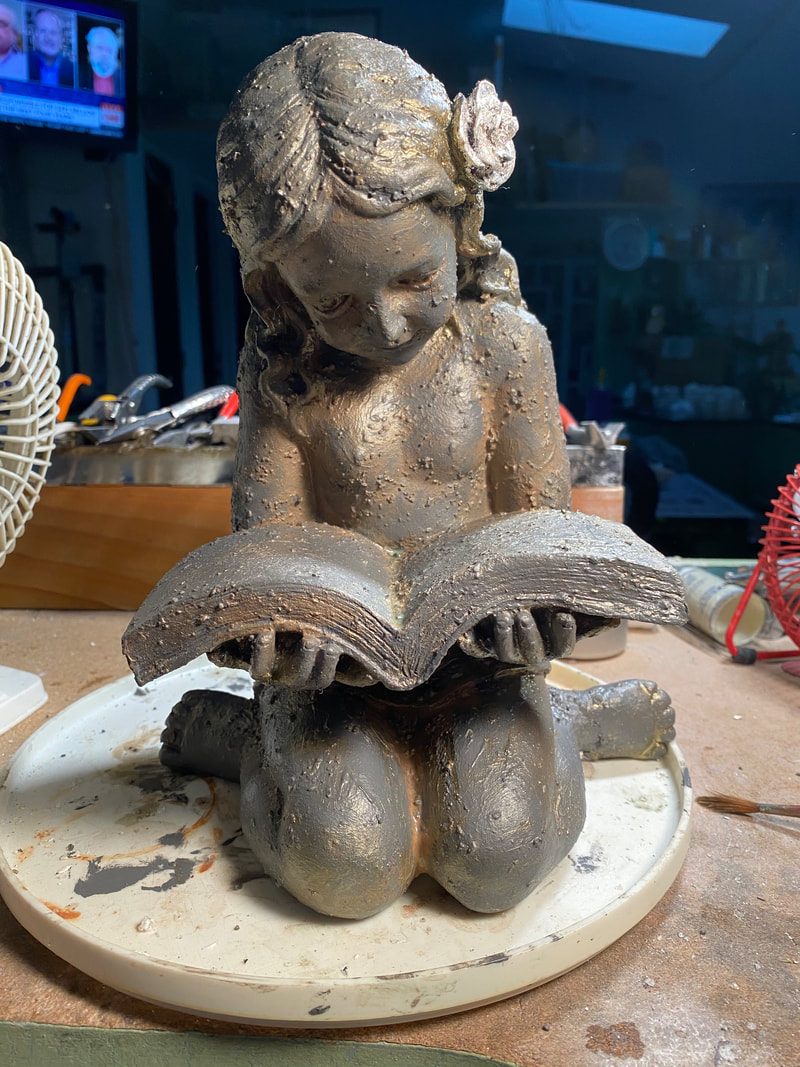
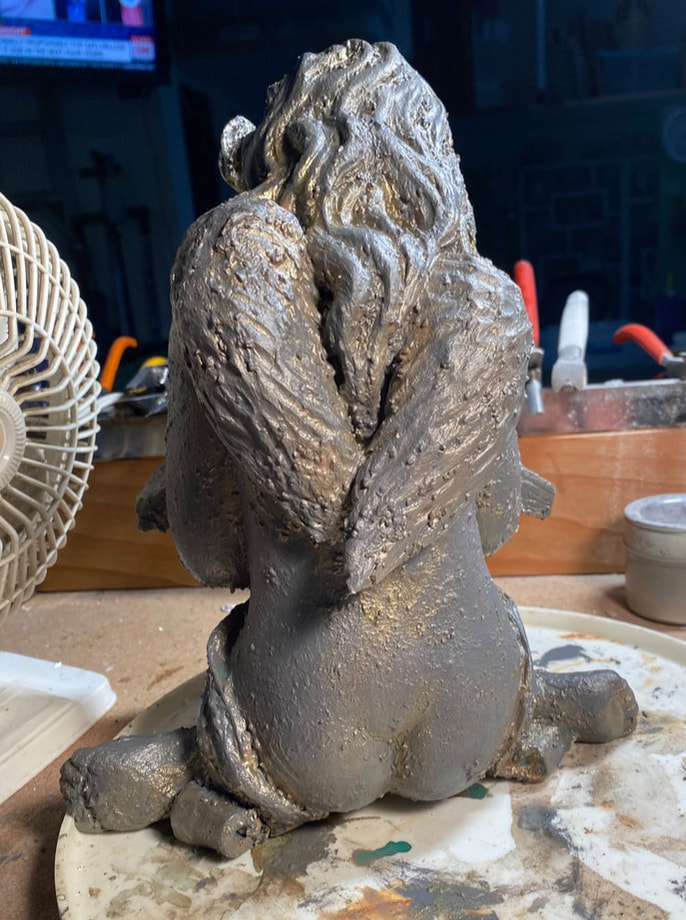
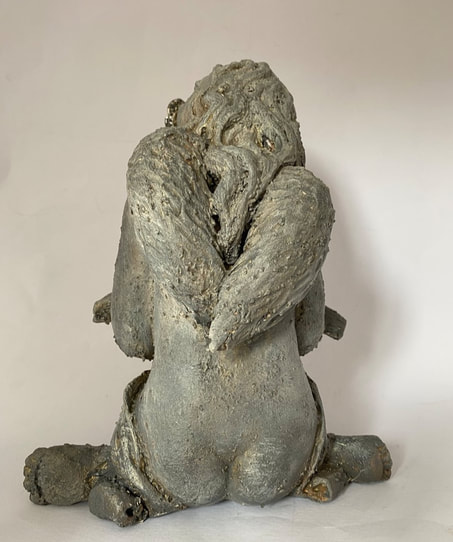 Over the years, and even before my most recent post about Toby the Bird Dog, former collectors have reached out. “I bought the cat you donated to Sac SPCA and my housekeeper broke his toes. I tried to glue it myself but…” “Someone stepped on my pendant. Can you replace broken stones?” “You made some custom pieces for my mother but they aren’t my style. Will you buy them back?” In the minds of some collectors, art comes with a lifetime-satisfaction guarantee, not to mention lifetime warranties. It’s true! When restoration issues arise, galleries habitually suggest that their clients contact the artist. I know this because I’ve had these conversations: “Hello, I bought one of your pieces from The-Gallery-That-Must-Not-Be-Named and they say I should call you…” (No commission on repairs, perhaps?) I find this so ironic. When it comes to their clients, galleries are possessive and, sometimes, downright paranoid––yet with good cause. I’ve seen artists handing out private business cards at gallery openings.Not at all respectful to those who ponied up for the wine and cheese! Here’s where possessiveness is a problem, though. Until an artist gets paid––and let’s be honest here, some galleries are less diligent about fulfilling their fiduciary responsibilities than they should be––and, unless the artist is in the habit of popping in and out of galleries, performing inventory checks (instead of being in her (or his) studio, making all that good art) the artist doesn't know what a gallery has sold until she gets paid. Imagine this scenario: Artist goes to a party and sees her (or his) painting on the hostess’s wall. “Oh! didn’t The-Gallery-That-Must-Not-Be-Named tell you?” says the hostess, “I told them we knew each other when I bought it. I’ve had it for a couple of months now!” It’s awkward. The artist is left thinking, “Gee, I should have called to thank her,” and “Wow, I thought I had a good working relationship with my gallery, built on mutual respect and trust––hey, wait a minute, I know why I didn’t call her! I still haven’t seen a check!” The terms “client” and “collector” and their relationship to “gallery” and “artist” can be explained like this: the people who buy art are, first and foremost, the galleries’ clients and, secondarily, the artists’ collectors–– and with the exception of a gallery event (an opening or private show) never the twain should meet. Unless something needs fixing. But I digress…  As a creator, am I not bound to my creations? After all, they are my children. But what about someone else’s child? Recently, I was asked to to restore a treasured totem gifted by a soul-dear friend. A poor little angel who had lost both wings and foot. My challenge: I couldn’t be sure what the sweet little creature was made of. It seemed to be cast out of resin, finished in a stone-like texture. I'd never worked with resins and I knew fired clay wouldn’t work at all, so off to Michaels I went, in search of inspiration. 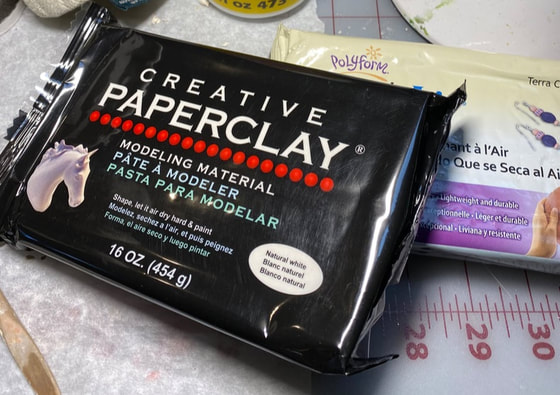 Paper clay! Easy to work, adheres to surfaces, dries in a few days with paintable surface–– at least that’s what the package said. I’d never worked with paper clay either but, being a kids’ craft product, I felt reasonably confident stepping outside my comfort zone. Paper clay is great for kids’ purposes, not messy and easy to work with. It sticks to itself (and to other surfaces) so I was able to build the angel’s missing back and foot onto her original form.
When I came to the wings I learned the drawbacks. Paper clay doesn’t hold an imprint like sculpture clay (it’s like pushing into bread dough) so I had to wait until the wings totally dried before adding detail. For this I used a foredoom and pumice wheels 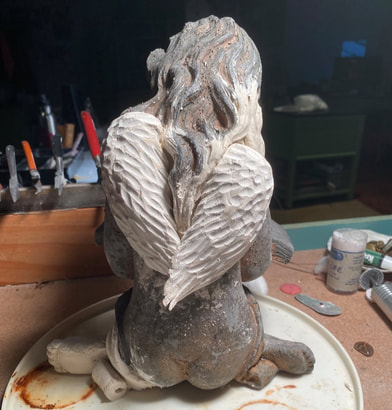 Finishing and painting followed. Golden Acrylic clear granular gel for texture followed by a combination of grey and bronze acrylic paint, softened afterward with a wash of Titan buff. As an afterthought ( or, perhaps, my signature) I silver leafed her flower.
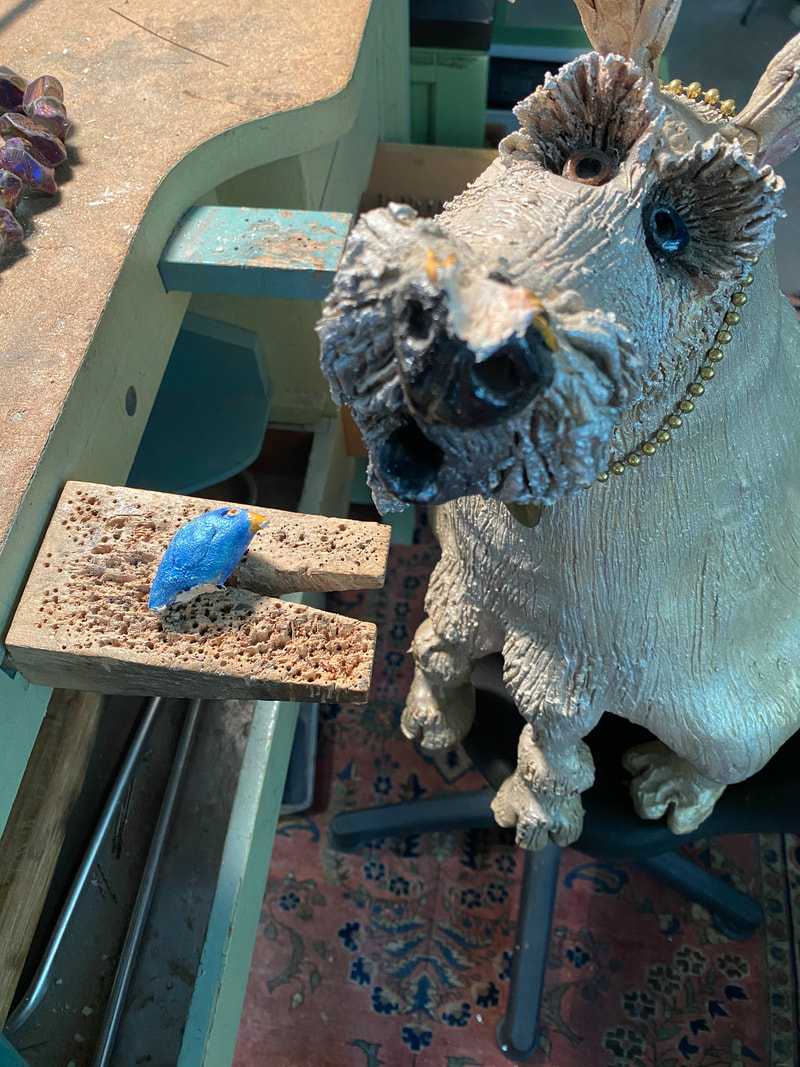
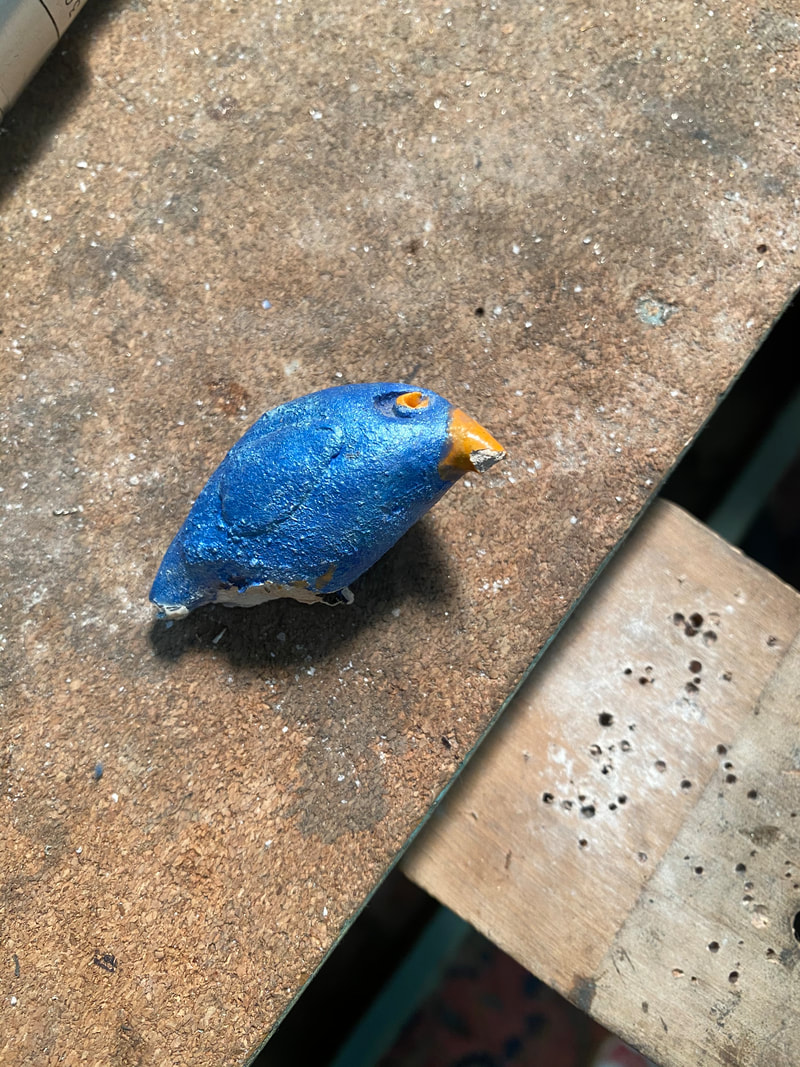
I suggested earlier that, for some, art comes with a lifetime guarantee. After working on this cherished angel, who wasn’t even my child to begin with, I understand. Art that someone loves is eternal. 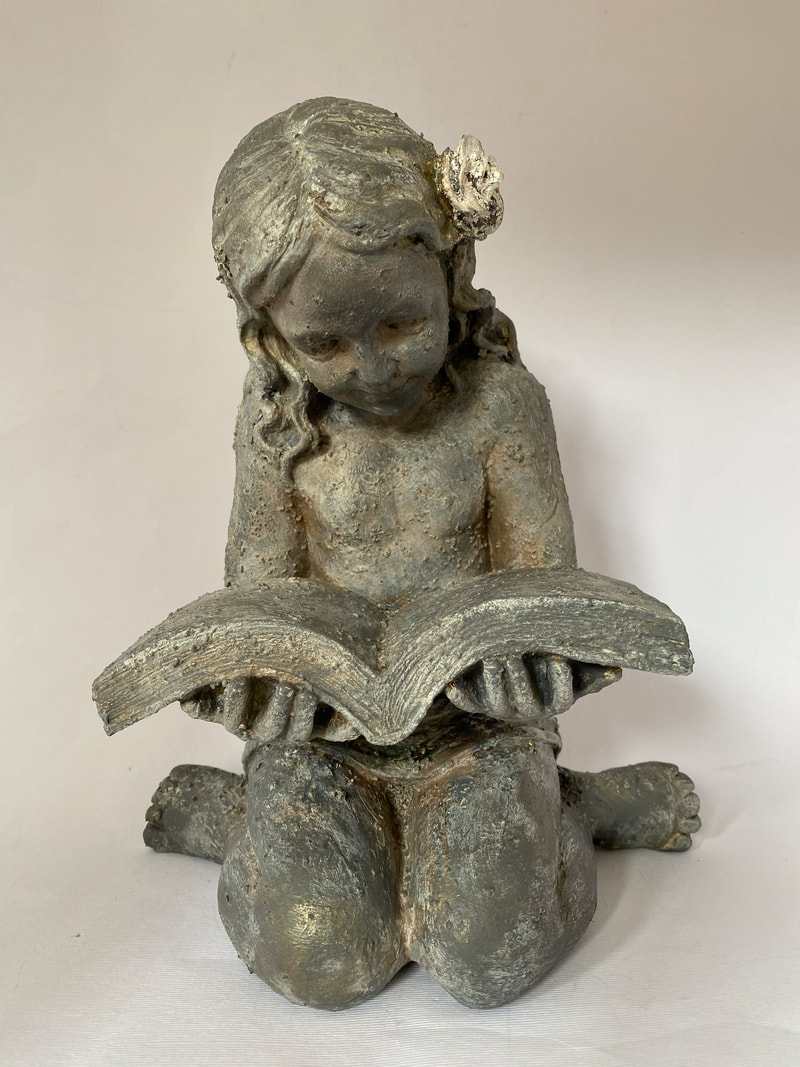 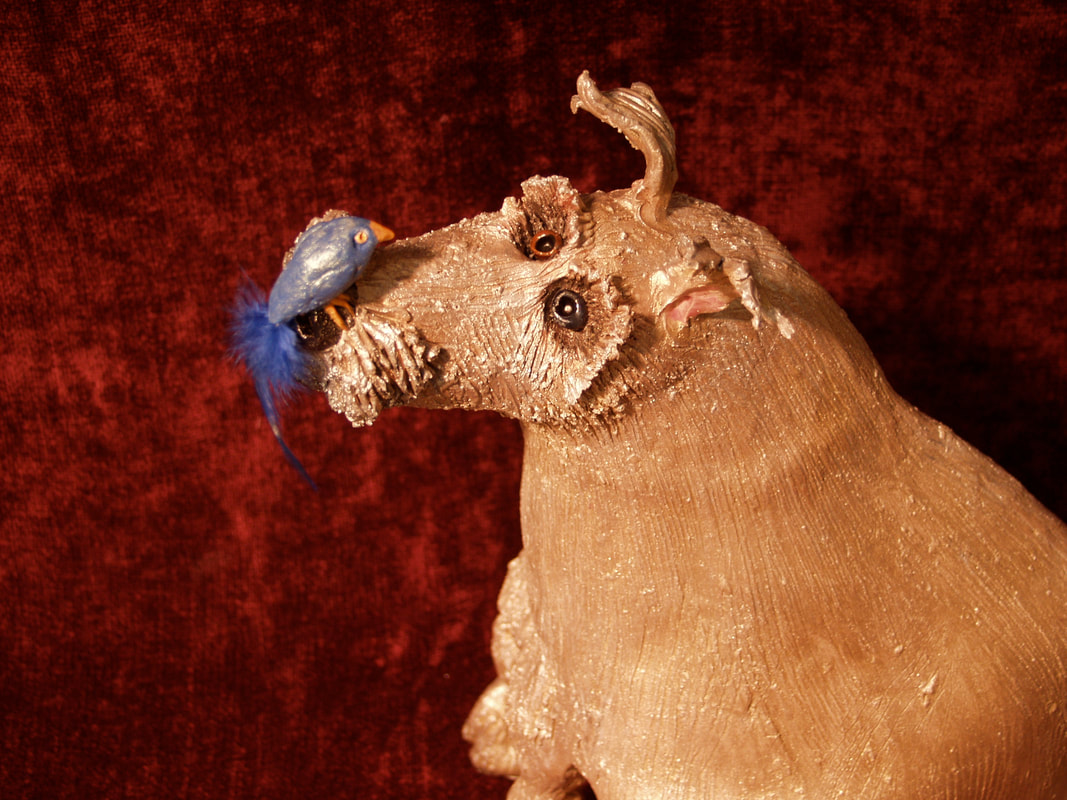 This is Toby. He's a Bird Dog. Once upon a time I was pretty well known for clay critters like Toby. Recently, I got an email from Toby's owner who explained that Toby has been a cherished member of their family for many, many years. The owner's son’s real-life dog was even named after Toby––and if that isn’t a Velveteen Rabbit moment, I can't say what is. The owner shared that Toby’s life experiences had taken a toll. Toby had withstood curious grand-child hands, plethoras of enthusiastic pets, and three separate household moves . Toby's Bluebird of Happiness' tail-feathers had been snapped off multiple times, and finally, during the last move, Bluebird cracked clean off Toby’s nose. Toby’s owner wanted to know: could Toby be fixed? Just to clarify, by “fixed” Toby's owner meant “repaired” and, as a long-time supporter of Sacramento’s SPCA, I feel it’s important to highlight this distinction. I asked if Toby could come to my studio and we’d see what might be done. When Toby arrived later that day my first thought was, "Damn! He looks pretty darn good for an old dog." His tag told me that he’d left my studio in 2002––which would make Toby about ninety-something in dog years yet , ironically, a mere pup in pottery years. Fun fact: the earliest known crockery dates back 20 millennia to what archeologists refer to as the Upper Paleolithic or Late Stone Age Period. After a brief examination––let’s call it a CAT scan, or would you prefer Toby’s “Lab” report?––besides the overall fading of his original copper color, the tip of Toby’s ear, one eyebrow, and part of his tail had been "docked", Bluebird had no tail feathers, one of her toes was missing, and her beak had been badly chipped.
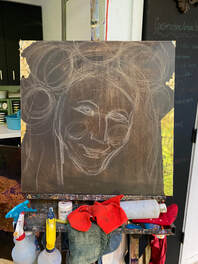
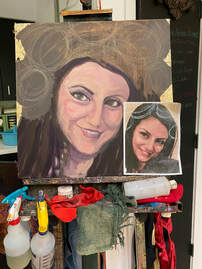
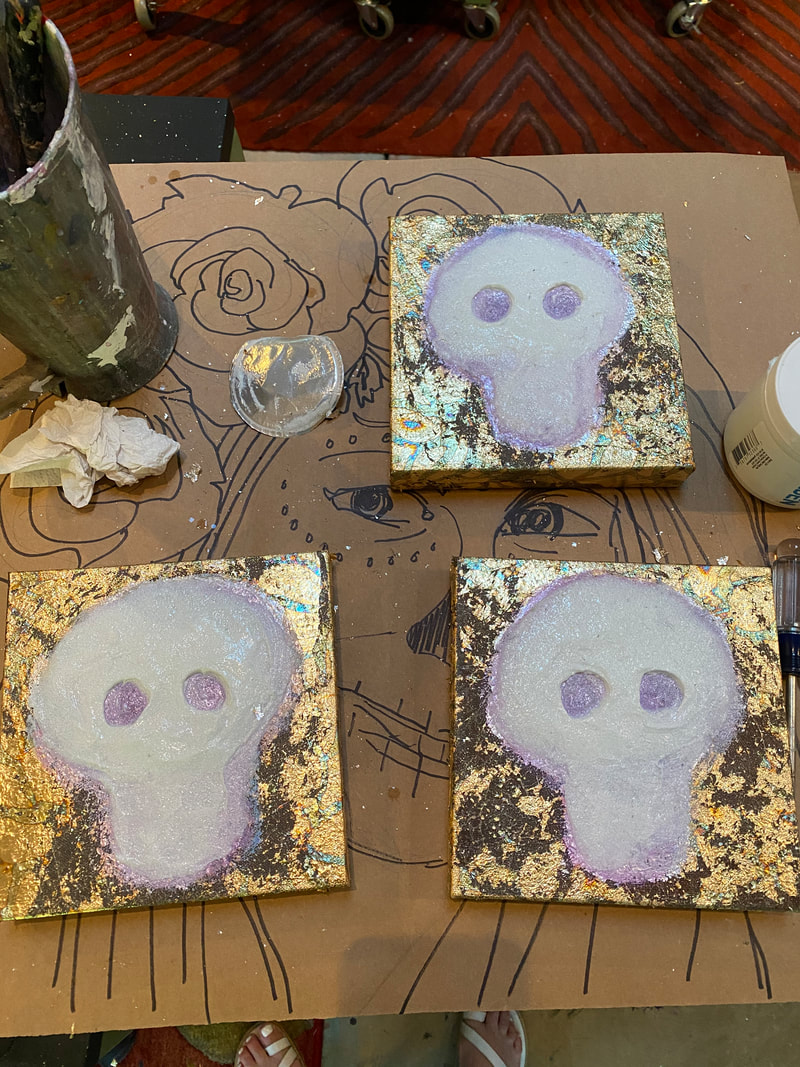
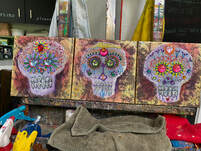
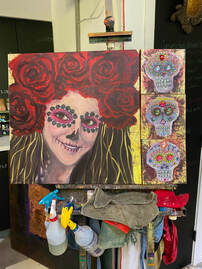
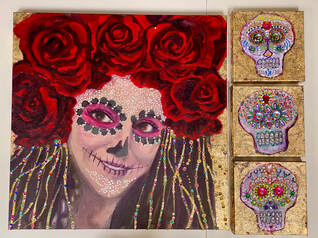
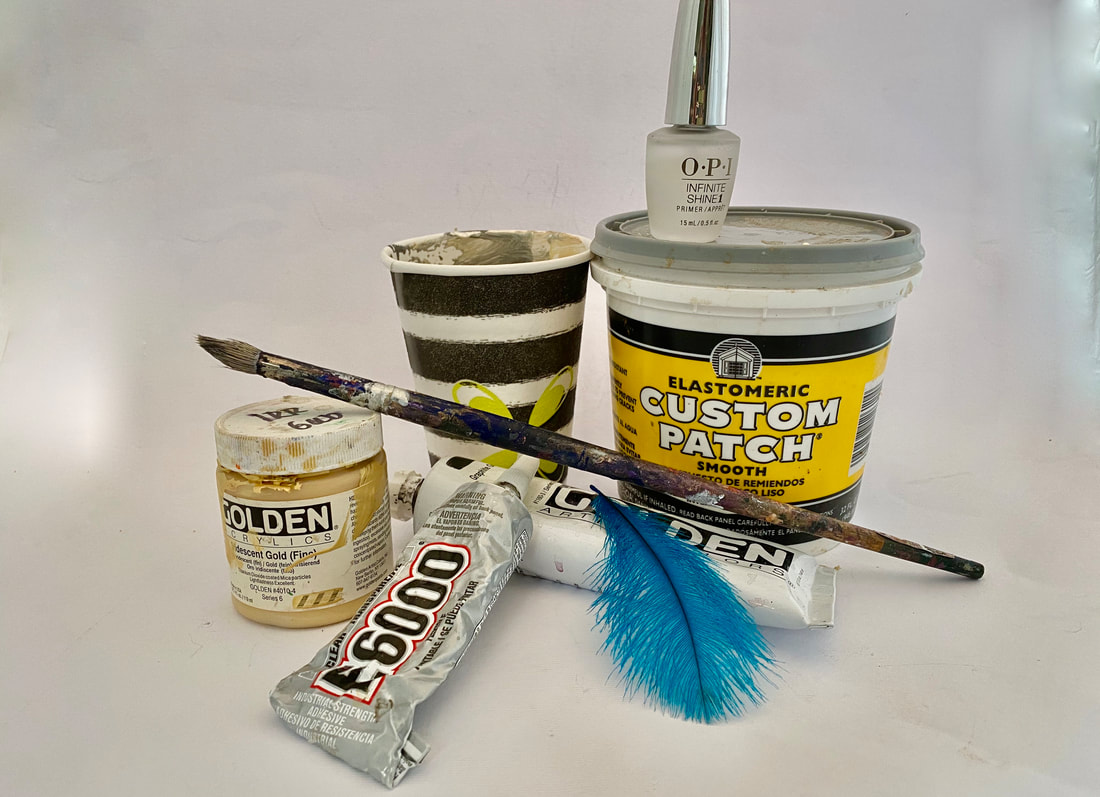 Artistic choices were made. As Toby's coat had faded to a lovely shade of platinum-gold, I decided not to return him to his original copper. Besides, isn't it unnerving when old-timers dye their hair to the colors of their youth? To my eye, it rarely translates well. My final thought: years from now, when all of us are dust, might a future archeologist unearth Toby-shards and wonder about the civilization that produced him? Who can know? What I do know is this: as a living artist I’m grateful that a creation of mine has been loved both long and well. It was a pleasure to assist in Toby's preservation. 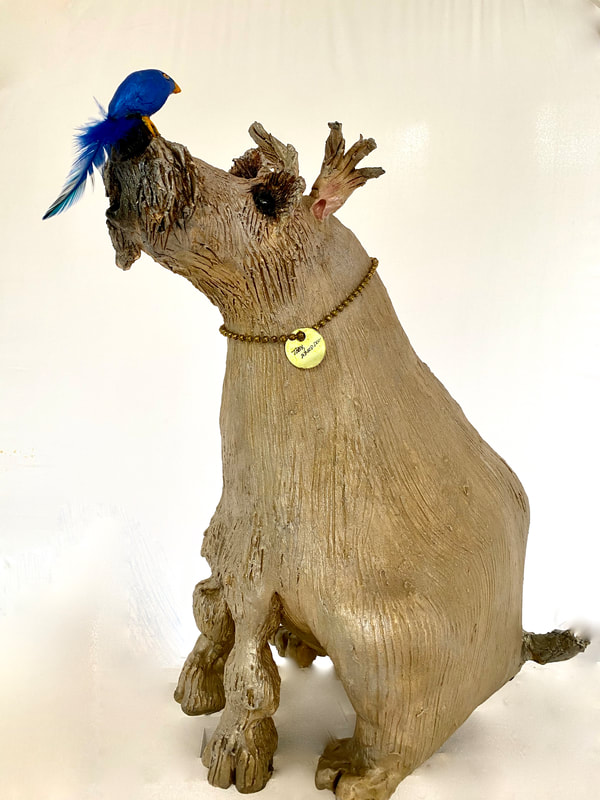 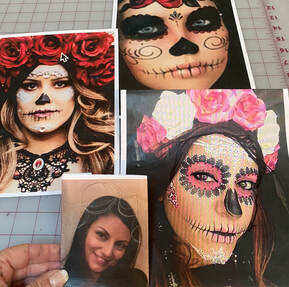 About a month ago, I got a call from my sister-in-law’s youngest sister. “I have this friend Nick,” Bethany began,“His wife, Suzy, is the sweetest, kindest person in the world and they have twin daughters who were born on Suzy’s birthday. I know! Can you believe that? What are the odds? Anyway, Nick was saying Suzy’s so devoted to being their mom it’s like she doesn’t get to have her own birthday anymore and Nick wants to do something really special for her this year. He wants an artist to…” I suggested directing Nick to my website and, if he liked my work, he might contact me. Nick emailed the very next day. Nick wrote that Suzy loved all things Day of the Dead and what he was hoping for was her portrait in full Day of The Dead regalia … and he needed that painting to fit into a 36” x 28” niche. “Hmm,” I said, “that’s an odd size and I don’t stretch canvas but maybe there’s a work around. Are your okay with gold leaf and rhinestones?” Nick said the Magic Words. “You’re the artist. I trust your judgment.” Here's the work-around I came up with: one 24” x 24” canvas flanked by three 8” x 8” canvases. Suzy’s portrait would fill the big canvas and the three smaller canvases would be sugar skulls. As you can see from this mock-up on the floor of my studio, they nicely fill the 36” x 28” footprint. (Yes, visual pun intended.) 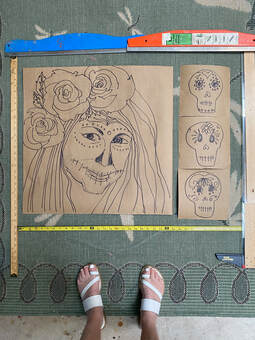 Once Nick gave the thumbs up I put on my smock. I started with black underpainting. Then I did a rough sketch of Suzy. Gold leaf came next. Then the portrait. Didn’t quite nail the angle of the head but, in my defense, I was working from a teeny tiny image and hey, it’s art, and art is subject to the artist's interpretation. Then I started in on the sugar sculls: black underpainting again, gold leaf, and iridescent pearl acrylic layered with glass bead gel, for texture and luminescence.
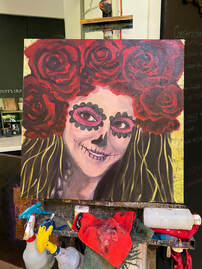
So far so good! Now for the embellishing. Nick said that red roses were Suzy’s favorite flower so that’s how I came up with her crown, Then I worked on her “make up”. I used pearl and glitter dimensional fabric paints for the facial tattoos because I wanted the textural quality, then I hand applied scads of tiny colorful rhinestones to the golden ribbons flowing from her crown. "Crystalizing” the sugar sculls followed after that.
The red background that I’d floated around the sugar sculls didn’t work as well as I thought it might so I covered it up with more gold leaf. (No, there’s no such thing as too much gold leaf.) Below: the completed “La Raina de Dia de Muertos” with Suzy and Nick. Happy birthday, Suzy! And The Thoughtful Husband of the Year Award goes to ...
 On Wednesday this week I was a guest on Capitol Public Radio's" Insight" hosted by Beth Ruyak. When Beth floated the invitation, it took me by surprise. When she called a day later, offering me a slot for the very next day, I was terrified. Still, I said yes. Something about stepping outside my comfort zone… Tuesday afternoon, Beth followed up with a “chat map” with questions that would guide to our conversation. I read Beth’s questions and wrote clever, thoughtful responses to each and every one. Who could predict that, when that techno-curtain lifted, foot-in-mouth would meet brain-in-fart? Historical Flashback: At the beginning of each and every performance I’d ever been in, I always fumbled my lines. And, of course, there was that painful appearance during a KVIE art auction... On Wednesday morning at 9:50 a.m., Beth began with this : "Have you ever been in those conversations where you find yourself thinking of the silver linings of the stay-at-home experience or those unexpected plus-times and good that come from unexpected outcomes? UPLIFT, every day, celebrates that kind of spirit. Today's guest, Sacramento artist Caren Halvorsen, seems to be in the midst of that part of the experience. Joining us by phone from her home studio today…” Somewhere between “Hello, Beth,” and “Thank you for inviting me,” the adrenaline hit. Inexplicably, I couldn’t seem to wrap my head around Beth’s first question. A question I already knew! A question I had a pretty solid answer for!!! Allow me to describe the experience: in the moment, it feels like being perched on the rim of a gigantic blender while an unseen finger pokes “frappe”. There’s a momentary free-fall right before the blades… 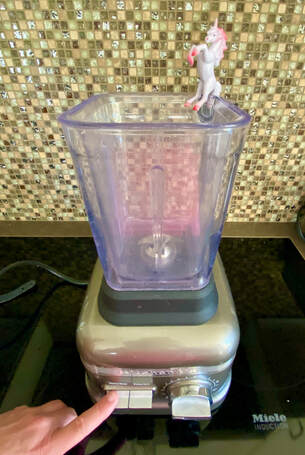 But then I remembered. I ALWAYS falter out of the gate. It’s part of my “process”. I admit it’s a flawed process, which I call "frappe or fight". Beth Ruyak was amazing! Sensing her guest was about to self-liquify, she pivoted her approach, which got me out of the blender and lurching toward topic. Because of Beth, the rest of the interview went better. Beth gets an A+ for her performance; I'll stick with pass/fail. Retrospectively, this is where I goofed: “me” got in the way of the message. And this is the message: If an #artgurlartifacts no-strings, free donation could help your business, contact me. 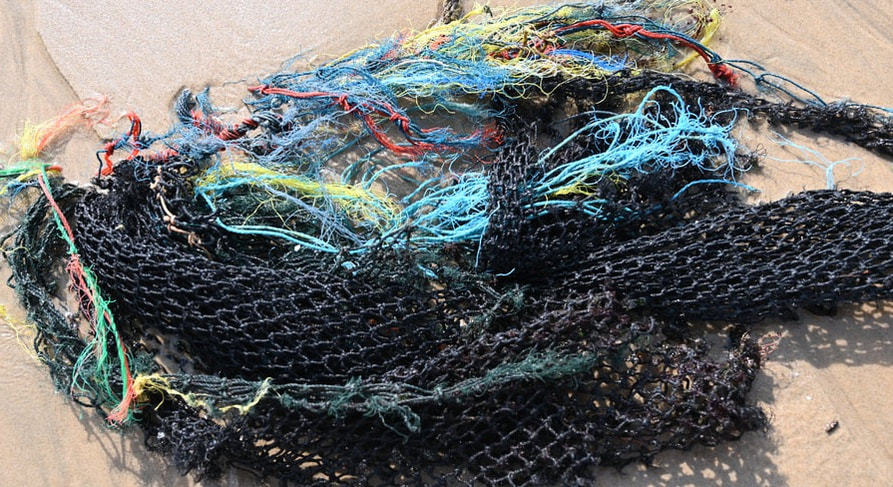 Here's the backstory: full disclosure, Beth Ruyak and I live on the same street and, in a recent and perfectly appropriate socially distanced conversation last weekend, I mentioned I’d been making so much jewelry during our shelter-in-place time that it would be great to do something helpful with it. I might have even have floated a “Bling-it-Forward-” hashtag. I confided to Beth that, in the prior week, I’d sent out letters to seven or eight self-employed and small business owning friends asking if I could donate some of what I'd been making, but hadn’t heard much back. That’s when Beth suggested a wider audience… My sincere thanks to Beth "The Bridge-Builder" Ruyak, and the amazing "Insight" team : Cintia Lopez Montes, Kyle S. McKinnon, and Aram Sarkissian. 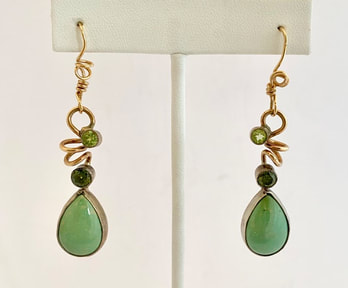 The bridge-building is working! These beauties are going out today! Stay strong Delta Mind Body Center . Click the link to learn about this dynamic women-owned business.
And, If you'd like to experience what it sounds like to free-fall into a whirring blender you can listen here. 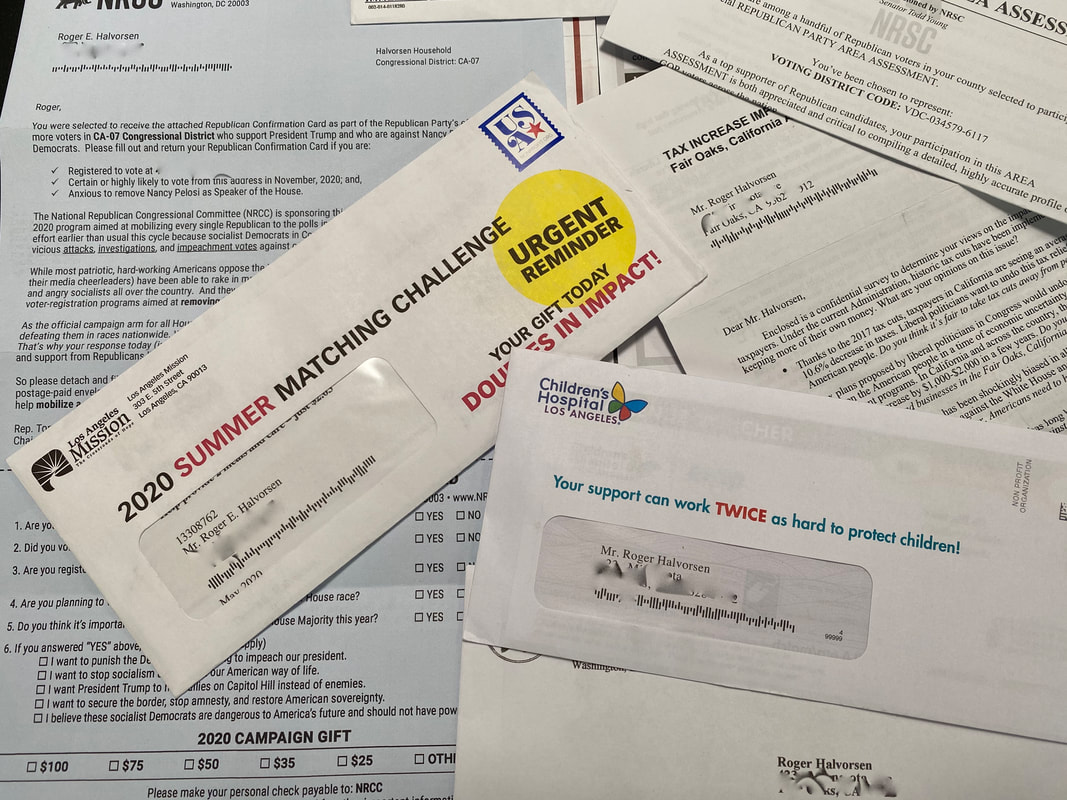 At first I found it entertaining ––the solicitations that my recently deceased father-in-law. received. Last November, after he passed, we forwarded Roger's mail in order to pay his bills and settle his estate. Since then, we’ve been barraged with the postal equivalent of late-night television-advo-mercials–you know the ones–– cures for erectile disfunction, hair-loss, and weight gain, images of battered puppies and disabled kittens with Sara McMcLachlan soundtrack, Peter Popoff's "Miracle Water". How do I say this? Roger had his causes and he wished to be well thought of. I say this with only a trace of judgement. My grandmother was the same. Her five and ten dollar donations, written at the end of each month from the reservoir of her modest household account, allowed her to feel “philanthropic”. Yet, with each stroke of her pen the hydra's head bisected and two new charities cropped up, pleading for aid. Not to be deterred, Grandmother sent additional checks, in incrementally diminished amounts. Often times, non-profits send "gifts". In my grandmother’s day, those gifts were mailing labels but today this unsolicited bounty has exploded. When Roger was alive he garnered laundry-loads of patriotic t-shirts from multiple veterans groups, a drawer-full of personalized notepads from law-enforcement organizations, a cluster of refrigerator magnets from Boys Clubs of America, stacks of overly-sentimental all-occasion note cards from Easter Seals, and my favorite, two pairs of blue and yellow butterfly-flower ankle socks, courtesy of the Children's Hospital of Los Angeles. Can you imagine a ninety-four year old man wearing these? It begs a fund-amental question; what comes first? The check-N-the mail or the egg? 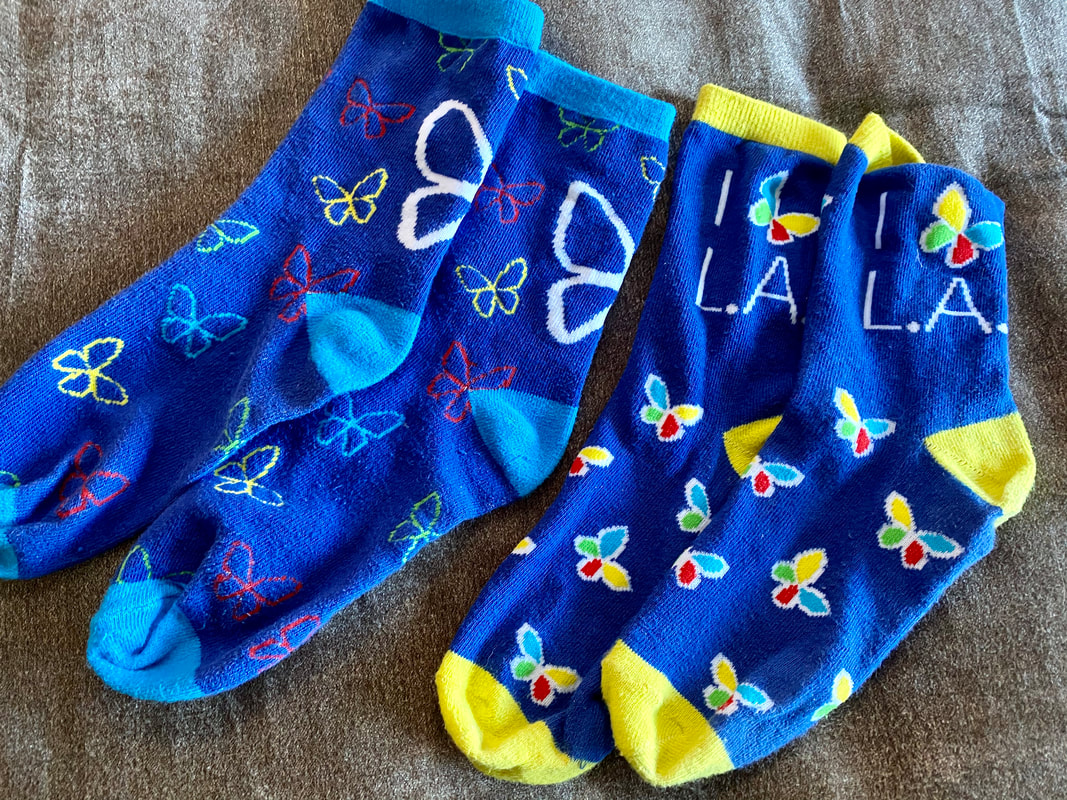 Seven months ago, Roger left us yet his mail continues on. After his contributions stopped, most of his non-profits "got it"––but not the Republican party! Just in the last week, Roger has received solicitations from: Melania Trump, Mike Pence, Newt Gingrich, Senator Todd Young of the National Republican Senatorial Committee, The Howard Jarvis Taxpayers Association, The Remembrance Project, The Heritage Foundation, and Judicial Watch. There've been a slurry of surveys as well. Just today we received the 2020 National Illegal Alien Election Impact Survey, the Fair Oaks Tax Increase Impact Survey Registration, the Sacramento County Republican Party Area Assessment, and the 2020 Republican Voter Confirmation Card, In all these correspondences two themes are consistent, politically charged rhetoric and monetary requests . Ah, the opportunities that Sheltering At Home supply! I considered filling out Roger's surveys, just to mess with their statistics, but his signature is required and, even though I'm a "leftist-liberal", I do know right from wrong. Still, it seemed a shame to let those tax-payer-funded prepaid-return envelopes go to waste. So, I've been using them to send these: To Whom It May Concern: This is to notify you that Roger Halvorsen is deceased. As Mr. Halvorsen has no further need of your well-intentioned gifts (including but not limited to: mailing labels, t-shirts, greeting cards, calendars, note cards, refrigerator magnets, certificates, and shopping bags) his estate requests that you remove him from your mailing lists and, please, discontinue this barrage of bounty. If your solicitations are political, keep them coming. Requests on behalf of Donald Trump and those who promote his agenda will be shredded. No thank you for squandering tax-payers' dollars. See you in November! I think my project is working. Here's what came today. 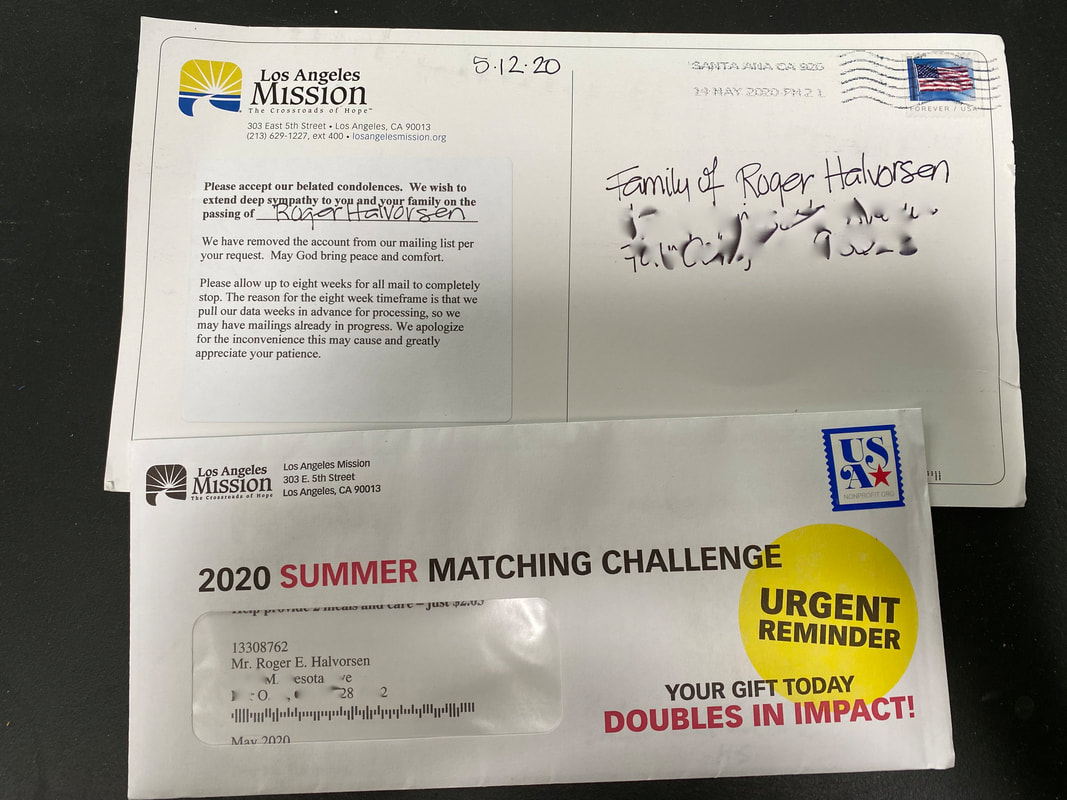 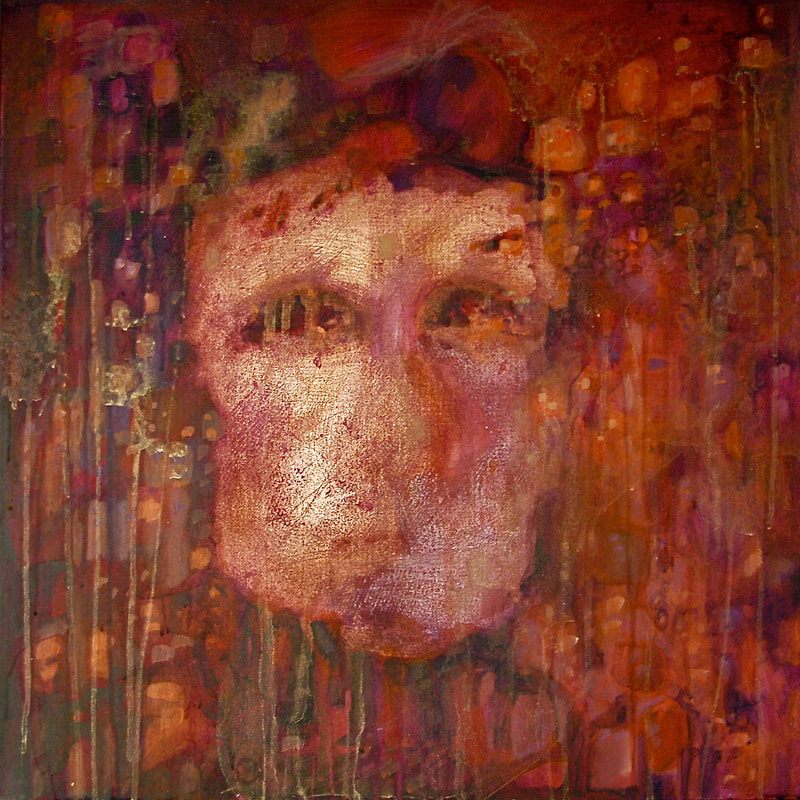 Until a month ago, did any of us imagine that a trip to the grocery store would become a Thrill Seeker’s Event? I didn’t. Until today…
In the Bel-Air parking lot, a woman––in full COVID armor (kitchen-gloved and face-masked)––stopped me… Wait. That isn’t exactly how it happened. I’d stopped first, when I saw her coming toward me on the narrow sidewalk. Thinking to offer her the “socially distanced” right-of-way, I stepped sideways into a planting bed, so I was surprised when she stopped, too. “Where’s your mask?” she said. Her tone seemed strident. “Sorry. ” I shrugged amidst the shrubbery. With anxious eyes she, stood her ground. Waiting. “I don’t have one,” I said. She fired back. “Why not?” Where to begin? That medical grade masks are in limited supply and desperately needed by our health-care professionals? Or those with underlying health conditions? That most lay-people are careless (or clueless) about wearing masks correctly? That masks are not a panacea nor are they meant to assuage the importance of appropriate social distancing, like the kind I'm performing right now by standing in a freaking hedge? And, while we’re on the subject, why are you wearing a mask ? Is it to protect you from me or me from you? What I said instead was, “Sorry.” Her tone upshifted from strident to desperate. “You need to be wearing a mask! Every time you go outside! My daughter is a doctor …” It was a cough-into-the-hand instead of elbow reaction, which I immediately regretted, when I said, “My husband is a doctor, too." The sidewalk separating us became a chasm. “How could he!” she said. “He … let you out of your house? Like that?” Shocked, perhaps horrified––hard to fathom what was going on behind that mask of hers––she pushed her cart past me, living the acrid scent of hand sanitizer in her wake. An acknowledgement: I suck at confrontation. Ever since childhood, when met with anger I find myself in The Place of Shame. It was in that Place––while slinking my cart alongside the aisles and avoiding eye contact––a voice nearby asked, “How’s your day going?” There was something in that voice, something friendly. So I looked up. A white-jacketed (and mask-wearing) Bel-Air employee was standing next to a non-masked female co-worker. Perhaps it was their juxtaposition that prompted me to answer candidly. “I just got Mask-Shamed in the parking lot,” I said. The man and his co-worker laughed. “Yeah, we’ve been seeing a lot of that. Don’t let it bother you. You aren't required to wear a mask to shop here," he said. "Some people,” he added, "It makes them feel righteous." The co-worker offered up a compassionate smile. “They’re afraid,” she said. I could tell from the creases around the masked-man’s eyes that he was smiling, too. "So, tell us what you've been doing to stay sane? Any projects you’re working on? What are you watching on Netflix? Got your garden in? Drinking more than usual these days?” The smile behind his mask became a grin. Which made me grin. And the Place of Shame fell away. “So… How’s your day going, now?” he asked. "Thanks to The Masked Man and his Trusty Companion, absolutely terrific!" I replied. 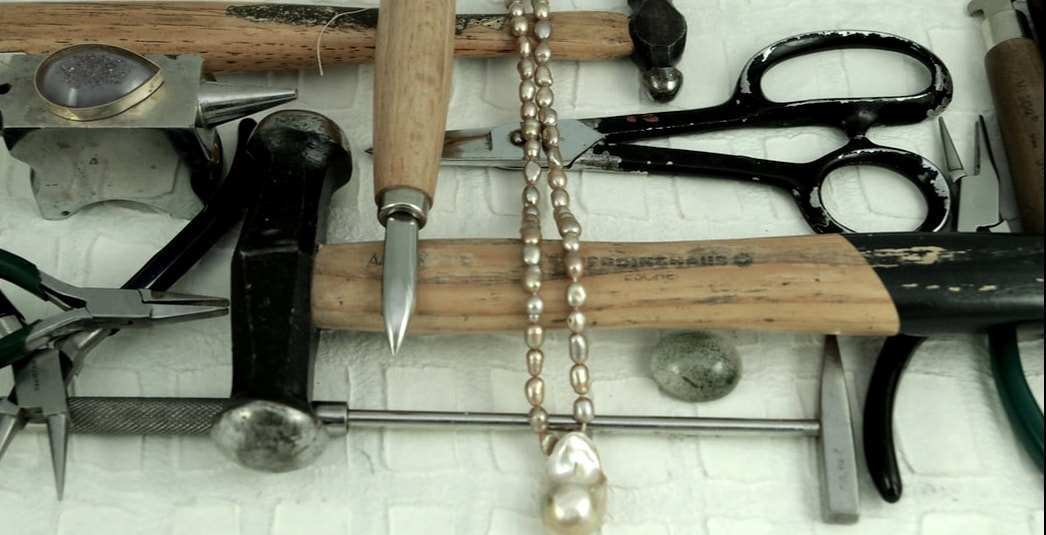 Artifact: an object made by a human being. Artgurl: a human being who makes art. A sad reality, worldwide pandemics and social distancing are good for just two types of creatures: dogs and artists. The former are currently enjoying multiple daily walks, unlimited treats which, unlike toilet paper, can still be found on the grocery store shelves, and, desperate for interaction, their sheltering-at -home parents now fully appreciate the moniker "man's best friend". Artists, as a general rule, do well with social-distancing. Solitude, for most of us, is a necessary component for creativity. Sure, artists can be social creatures but when inspiration (our Muse) smacks us upside the head, we prefer hunkering down. Speaking for myself, social distancing has become an opportunity to tackle some back-burner projects.(All artists have them.) First, I started sewing again. 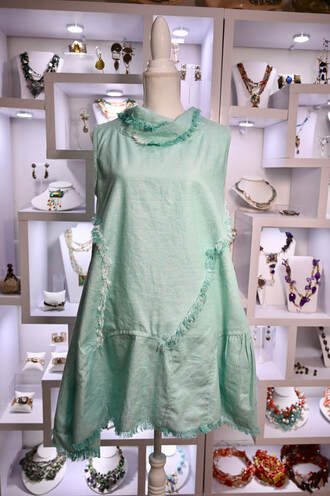 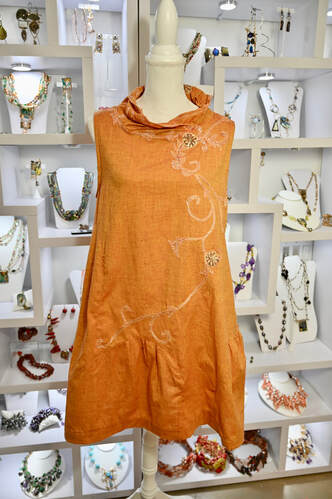 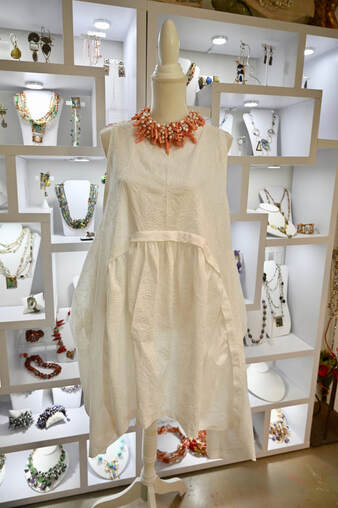 Then I did appliqué. Very handy for covering up stains and moth holes, by the way. 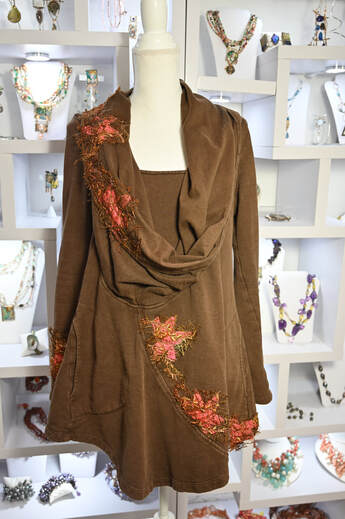 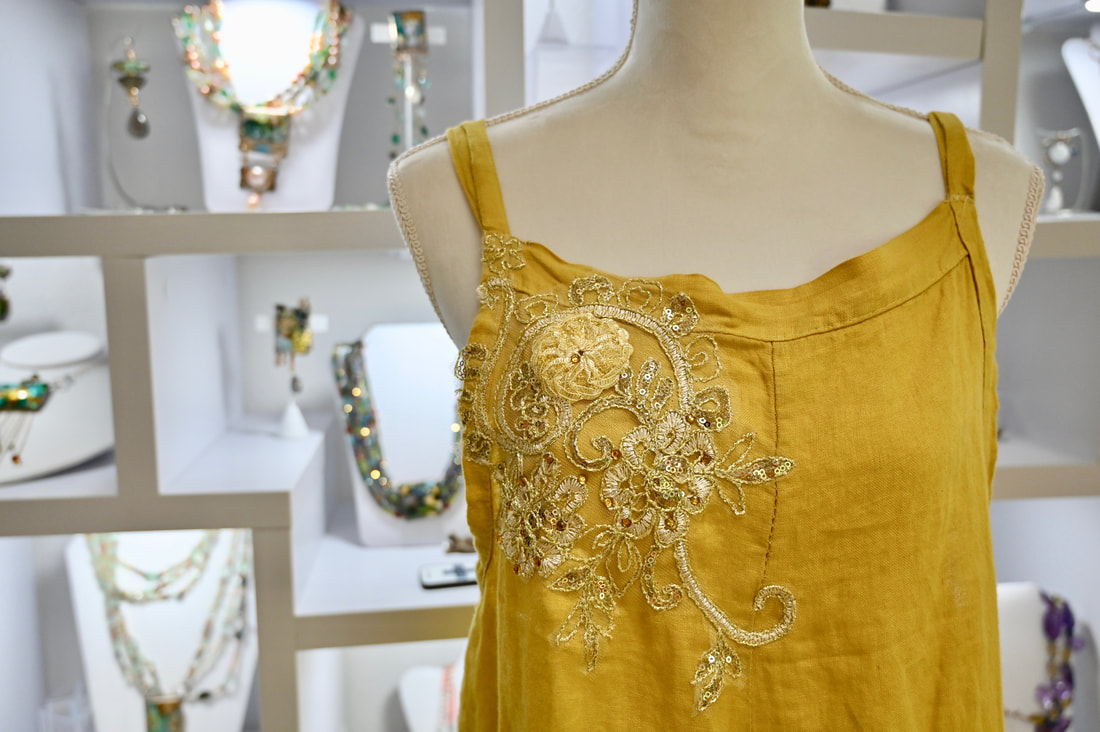 That got me through my first week of social distancing.
Since then I've been working my way through decades of back-burner projects. I'll be posting those "artifacts" on Instagram and Facebook under the hashtag #artgurlartifacts. As you hunker down, both for the protection of yourself and others, I invite you to follow along. And please, STAY WELL!  While listening to NPR this week, I caught a segment of This American Life*. The piece was entitled “The Show Of Delights” and in the prologue, Ira Glass opens by saying,” In these dark, and confusing, and combative times, where in just one month-- and it's a month that doesn't feel that atypical-- we have impeachment hearings, and Australia on fire, and a near war with Iran, and a deadly virus spreading around the world. We thought here at our show, we would try the most radical counter-programming possible. So today, we bring you our show about delight.” He then passes narration to his co-worker Bim Adewunmi . “ So there's this poet that I discovered a couple of years ago.” Adewunmi says. “He's called Ross Gay, and he's written a book where he basically keeps track of the things that delight him. And that's things, that's people, that's moments, whatever… the word he used was "negligence." He said it's a negligence if people don't take the time to honor the things that they take delight in, but more importantly, that they share the things that they take delight in. And if you don't do that, there's a loss there. You have to do it to achieve humanity. You have to share delight.” 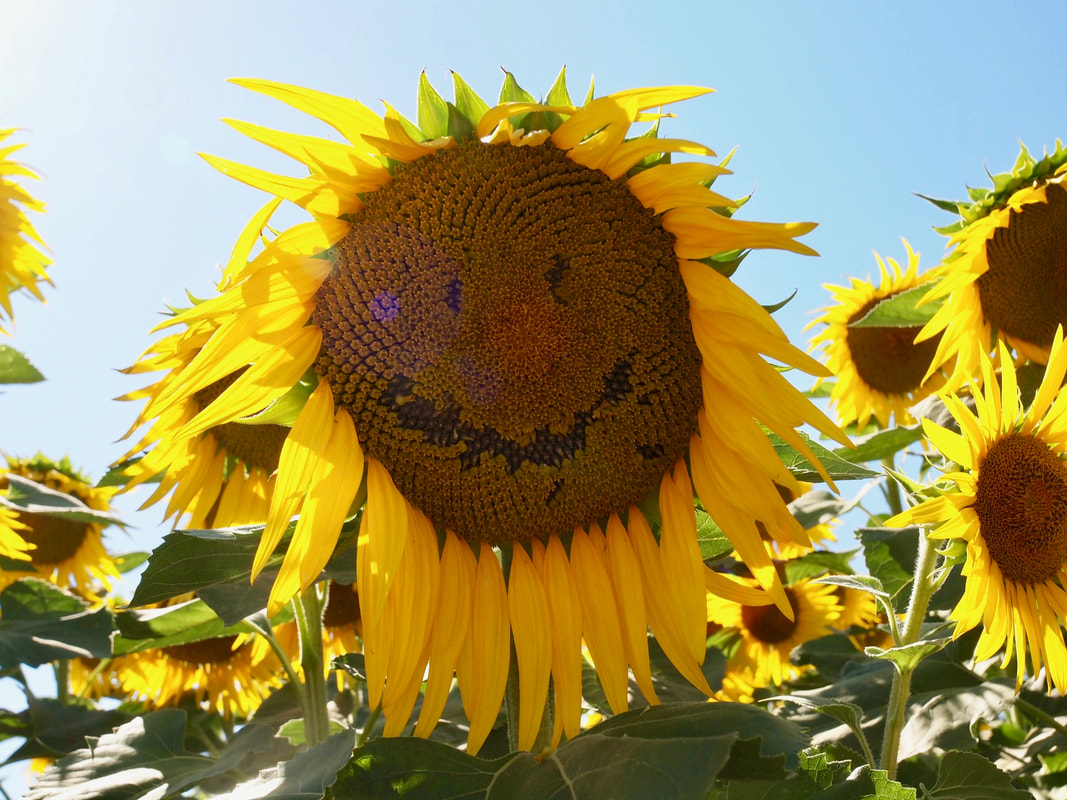 NPR calls it a “Driveway Moment”. Oprah calls it an “Ah-ha!” Even the ancient Greeks had a word for it. Epiphany. Whatever it’s called, I had one. Only three days earlier, I’d set up an Instagram account. I’d done it because one of my fellow wizards suggested that it was a “good platform for creative people to share what we do”. I still wasn’t sure how it applied to me…until I heard this NPR broadcast. 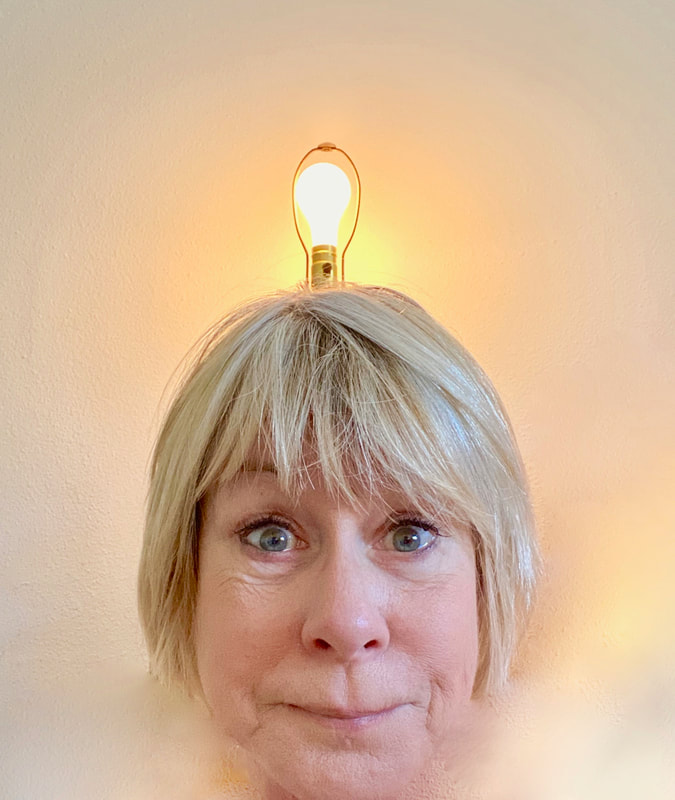 During my time on this planet, I must have taken over a gazillion photographs. This is because, each and every day, I see things, which ––to me––are beautiful  or heartwarming...  or amusing... 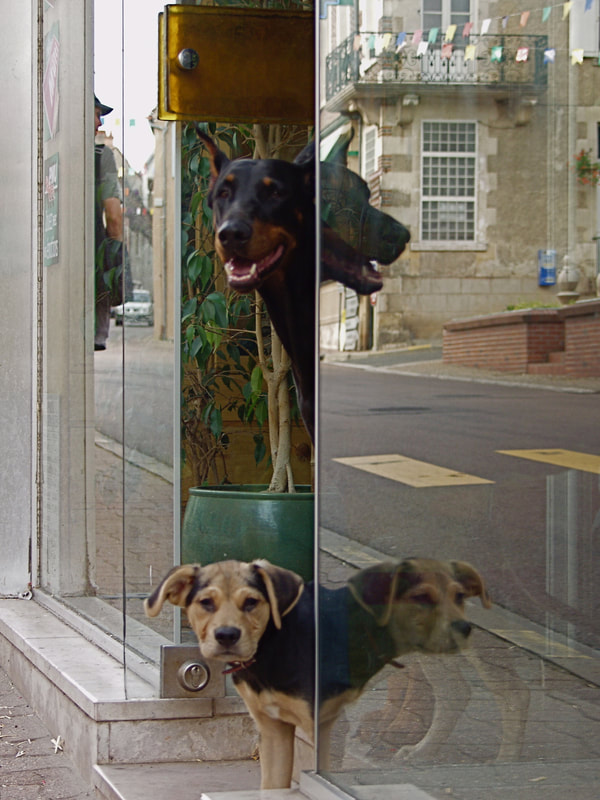 or poignant. 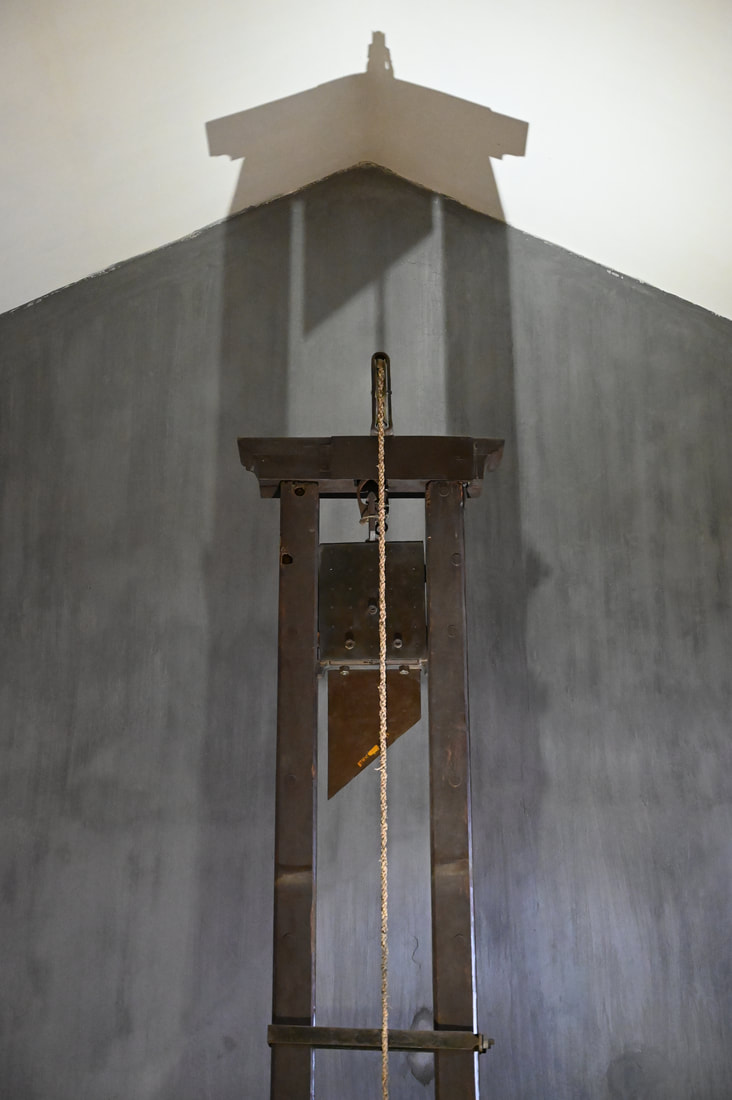 After hearing about the poet, Ross Gay, who, for an entire year, charted and wrote about the things that delighted him, I thought about all the images I’d taken that filed me with delight, yet seldom shared.
I thought I might build on Ross Gay’s work by introducing the concept of “delightenment”, which I define as “the sharing of images, thoughts, and experiences with the sole purpose of connection rather than disaffection”. Hello Instagram! And if you like the idea of #seekingdelightenment" , come follow me! * Take this link to enjoy This American Life’s “The Show of Delights” for yourself. |


 RSS Feed